
Millions of Americans live in communities governed by homeowners associations. Many do not realize that unpaid association assessments can become liens against their property—and, in some states, lead to foreclosure even when every mortgage payment has been made.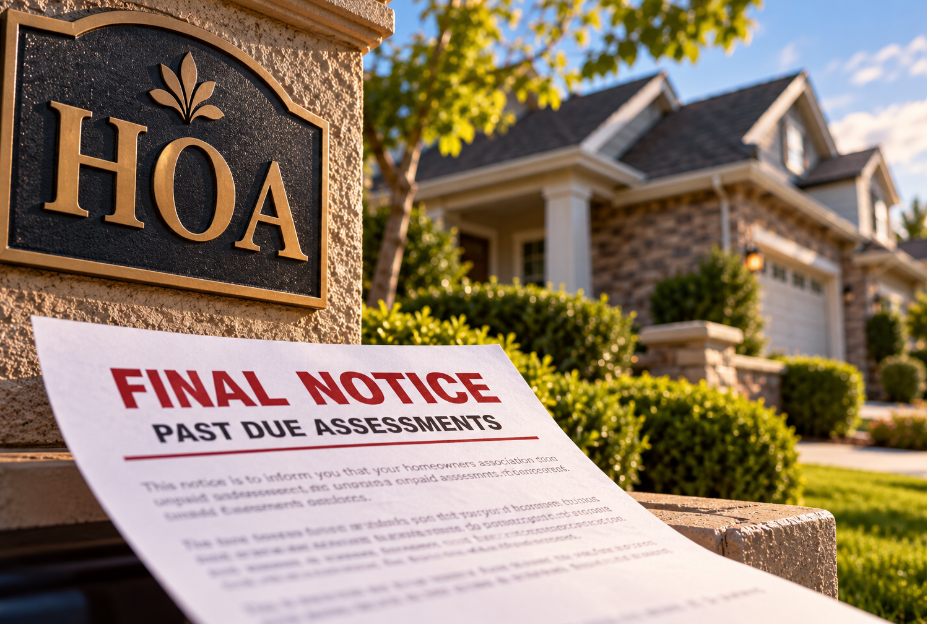
A homeowner purchases a house in a planned community, makes the monthly mortgage payments, pays property taxes, and maintains insurance.
But after a financial setback, the homeowner falls behind on homeowners association assessments.
What begins as several hundred dollars in unpaid dues grows as late charges, interest, collection expenses, and potentially attorney fees are added.
Eventually, the homeowner receives a notice warning that the association has placed a lien against the property.
Then comes an even more alarming possibility: foreclosure.
For homeowners who associate foreclosure exclusively with mortgage default, the prospect can be difficult to understand.
How can an organization responsible for maintaining common areas, enforcing community rules, and collecting assessments have the authority to force the sale of someone's home?
The answer lies in a separate system of property rights and lien enforcement that operates alongside traditional mortgage foreclosure.
In many jurisdictions, homeowners associations possess statutory or contractual rights to place liens on properties for unpaid assessments and, under specified conditions, enforce those liens through foreclosure.
The consequences can be substantial, particularly when a relatively modest assessment debt threatens property worth hundreds of thousands of dollars.
How Homeowners Associations Obtain the Power to Place Liens
Homeowners associations are generally created to manage common-interest communities, including planned developments, condominiums, and certain residential subdivisions.
Their responsibilities may include maintaining common areas, managing shared facilities, purchasing insurance, enforcing governing documents, and collecting assessments from property owners.
When a homeowner purchases property within such a community, the property is generally subject to recorded covenants, conditions, and restrictions, often called CC&Rs.
These governing documents establish obligations that can include regular assessments and special assessments for community expenses.
State laws may provide additional authority for associations to collect unpaid amounts.
In many states, unpaid assessments can become a lien against the property.
A lien is a legal claim securing payment of an obligation. It does not automatically transfer ownership to the creditor, but it may provide a mechanism for enforcing the debt against the property.
Depending on applicable law, the association may be required to record a lien, provide specified notices, or satisfy other conditions before pursuing foreclosure.
The important distinction is that the association's claim arises independently of the homeowner's mortgage.
A homeowner can therefore be current on mortgage payments while simultaneously being in default on association assessments.
How a Small Assessment Debt Can Become a Larger Financial Problem
HOA assessments may initially appear modest compared with a monthly mortgage payment.
But unpaid balances can increase as additional assessments come due.
Depending on state law and the association's governing documents, the account may also accrue late charges, interest, collection expenses, and recoverable attorney fees.
Consider a hypothetical homeowner who falls behind by $1,200.
If the delinquency remains unresolved, additional assessments and authorized charges may increase the amount required to bring the account current.
When the association refers the account to a collection agency or attorney, the homeowner may also face legally recoverable collection costs.
The resulting balance can become substantially greater than the original delinquency.
However, associations do not have unlimited authority to impose charges.
State statutes may restrict late fees, interest rates, collection practices, and the types of expenses that can be added to an assessment lien.
The enforceability of particular charges depends on the applicable law and governing documents.
For homeowners, the danger is that a manageable assessment delinquency may develop into a more complicated dispute involving collection expenses and potential foreclosure.
Can an HOA Really Foreclose on a Home?
Yes. In numerous states, associations can enforce qualifying assessment liens through foreclosure.
But the procedures and restrictions differ considerably.
Some states permit nonjudicial foreclosure under specified conditions. Others require judicial proceedings or impose additional limitations.
Certain jurisdictions establish minimum delinquency amounts or waiting periods before an association may initiate foreclosure.
For example, California Civil Code § 5720 generally restricts foreclosure of an HOA assessment lien unless the delinquent assessments, excluding specified additional charges, equal or exceed $1,800, or the assessments are more than 12 months delinquent.
California law also establishes notice and procedural requirements for association lien enforcement.
The statute does not mean that every HOA debt exceeding $1,800 automatically permits foreclosure. Other legal requirements must also be satisfied.
In other states, different thresholds, procedures, and homeowner protections apply.
The larger point is that an HOA foreclosure is not simply an ordinary debt collection lawsuit.
Under applicable law, it can involve the forced sale of real property.
The Difference Between Mortgage Foreclosure and HOA Foreclosure
Mortgage foreclosure and HOA foreclosure may produce similar consequences, but the underlying obligations are different.
A mortgage foreclosure generally involves enforcing a loan secured by real estate.
The lender or another authorized party seeks to recover amounts owed under the mortgage obligation.
An HOA foreclosure generally involves enforcing a lien securing unpaid assessments or other obligations that applicable law permits the association to collect through the lien.
The association is not necessarily seeking to recover a mortgage loan.
Instead, it is attempting to enforce obligations associated with ownership in a common-interest development.
This distinction becomes especially important when determining lien priority.
A home may be subject to a first mortgage, a second mortgage, property tax liens, and an association assessment lien.
The legal relationship among those claims can determine which creditors receive payment from a foreclosure sale and whether particular liens survive the transaction.
Those rules vary substantially by state.
The Controversy Over HOA Superpriority Liens
One of the most consequential issues in HOA foreclosure law concerns superpriority liens.
Ordinarily, lien priority depends on factors including recording dates, statutory rules, and the nature of the underlying obligation.
A first mortgage generally occupies a senior position relative to many subsequently recorded liens.
However, some states grant qualifying portions of homeowners association assessment liens a special priority over certain earlier-recorded interests.
This is commonly called superpriority status.
Nevada provides a prominent example.
Under Nevada Revised Statutes § 116.3116, specified portions of a common-interest community association's lien may receive priority over certain other liens, subject to the statute's requirements and exceptions.
Nevada's HOA foreclosure laws have generated substantial litigation involving lenders, associations, investors, and homeowners.
Among the central questions has been whether an association foreclosure sale can extinguish a previously recorded first deed of trust under particular circumstances.
The Nevada Supreme Court addressed significant aspects of these issues in SFR Investments Pool 1, LLC v. U.S. Bank, N.A., 334 P.3d 408 (Nev. 2014).
Subsequent decisions and statutory changes have addressed additional questions concerning lien priority, tender of the superpriority amount, notice, and foreclosure procedures.
The outcome in any particular case depends on the governing law and facts.
The broader significance is clear: an HOA assessment lien can sometimes affect not only the homeowner's ownership interest but also the security interests of mortgage lenders.
That possibility makes HOA lien enforcement an important issue for the entire real estate finance industry.
What Happens to the Mortgage After an HOA Foreclosure?
A common misconception is that an HOA foreclosure automatically eliminates every mortgage or lien attached to the property.
That is not correct.
Whether a mortgage survives an HOA foreclosure depends on state law, lien priority, and the circumstances of the sale.
In some situations, the purchaser acquires property subject to an existing mortgage.
In others, enforcement of a qualifying senior or superpriority lien may extinguish particular junior interests.
The treatment of federal interests, including certain federally related mortgage liens, can raise additional legal questions.
The consequences may also differ depending on whether the association proceeds judicially or nonjudicially.
These distinctions matter to everyone involved.
Homeowners need to understand the potential loss of ownership and any continuing personal obligations.
Mortgage lenders must assess whether their security interests are at risk.
Foreclosure purchasers must determine which liens remain enforceable after the sale.
A low auction price does not necessarily mean the purchaser receives a property free of other obligations.
Why Mortgage Lenders Pay Attention to HOA Delinquencies
Because association liens can threaten property interests, mortgage lenders and servicers may monitor unpaid HOA assessments.
Loan documents frequently require borrowers to pay assessments or other charges that could create liens against the secured property.
When an association lien threatens the lender's collateral, the mortgage servicer may have contractual or legal grounds to take protective action.
Depending on the circumstances, that could include advancing funds to satisfy an assessment obligation and seeking reimbursement from the borrower.
Such advances may increase the amount owed under the mortgage, subject to the loan documents and applicable law.
This creates another connection between HOA lien enforcement and the broader mortgage default industry.
A homeowner who falls behind on association assessments may eventually encounter collection activity involving both the association and the mortgage servicer.
The precise rights and obligations depend on the governing documents, loan terms, and state law.
The Role of Collection Companies and Foreclosure Attorneys
Many homeowners associations do not handle serious delinquencies entirely through their own management staff.
Instead, they may retain collection companies, attorneys, or specialized service providers.
These outside parties may prepare notices, review account balances, record liens, communicate with homeowners, and initiate authorized enforcement proceedings.
Some firms handle association collections and foreclosure matters across multiple communities or jurisdictions.
As with mortgage default servicing, the use of specialized contractors can make collection processes more efficient.
But the involvement of outside service providers also raises questions about oversight and accountability.
An association remains responsible for complying with applicable legal obligations, even when certain tasks are delegated.
Collection companies and attorneys may have their own obligations under applicable state and federal laws.
Whether the federal Fair Debt Collection Practices Act applies to a particular actor or activity depends on the circumstances and relevant legal standards.
Not every HOA collection communication is governed by identical rules.
For homeowners, understanding which entity is demanding payment and the legal basis for the charges is an important part of evaluating the claim.
What If the HOA's Accounting Is Wrong?
Association collection disputes can involve more than an inability to pay.
A homeowner may contend that payments were not properly credited, charges were unauthorized, assessments were incorrectly calculated, or required notices were not provided.
Other disputes may concern whether the association complied with its governing documents or statutory procedures before recording a lien.
These issues can become particularly important when the association seeks to enforce the debt against the property.
A recorded lien should reflect an obligation that is legally enforceable under the applicable requirements.
However, not every accounting error automatically invalidates a lien or foreclosure.
The legal consequences depend on the nature of the defect, governing law, and available remedies.
A homeowner disputing an HOA balance may need to examine account statements, payment records, recorded documents, and correspondence with the association.
The homeowner may also have rights to request specified records or challenge particular charges under state law.
Because foreclosure deadlines can continue while disputes are unresolved, timing may be critical.
Can a Homeowner Stop an HOA Foreclosure?
Homeowners facing association lien enforcement may have several potential options.
They may be able to pay the legally required amount to cure the delinquency, negotiate an installment arrangement, challenge improper charges, or pursue dispute resolution procedures.
Some states require associations to provide opportunities for payment plans or alternative dispute resolution under specified circumstances.
In California, for example, Civil Code § 5665 provides procedures relating to an owner's request to discuss a payment plan for delinquent assessments.
Other provisions establish notice requirements and additional protections governing association assessment collections.
In certain circumstances, homeowners may seek judicial relief to challenge an improper lien or foreclosure.
But a dispute over the amount owed does not necessarily stop a scheduled sale automatically.
The homeowner must determine whether applicable law, an agreement, or a court order actually prevents the foreclosure from proceeding.
As with mortgage foreclosure, waiting until the final stages of enforcement can substantially limit available options.
The Question of Proportionality
HOA foreclosure raises a broader issue about the relationship between the amount of a debt and the value of the property securing it.
A homeowner might possess a residence worth several hundred thousand dollars while owing only a few thousand dollars in unpaid assessments and associated charges.
Under applicable law, the association may nevertheless possess a lien that can ultimately be enforced against the property.
Supporters of HOA lien enforcement emphasize that associations depend on assessments to maintain common facilities and meet financial obligations.
When some homeowners fail to pay, the resulting shortfall may affect other residents who continue making their required contributions.
Associations therefore need effective methods of collecting legitimate debts.
Critics question whether foreclosure is an appropriate remedy for relatively modest delinquencies, particularly when collection costs can increase the amount owed.
They also raise concerns about notice, procedural complexity, and the risk that homeowners may lose valuable equity through a forced sale.
These competing considerations have led legislatures to establish different restrictions and protections.
The legal framework reflects an ongoing effort to balance an association's need to collect assessments against the serious consequences of foreclosure.
The Financial Stakes for Homeowners
The potential loss of a home over association assessments illustrates why HOA obligations should not be treated as insignificant.
Unlike an ordinary unsecured debt, an assessment lien may attach directly to the property.
That gives the association a potentially powerful enforcement mechanism.
For homeowners, the financial consequences may extend far beyond the original delinquency.
A foreclosure can result in the loss of ownership, litigation expenses, disputes involving remaining liens, and uncertainty about the distribution of sale proceeds.
The actual outcome depends on the property's value, the amount of secured debt, the foreclosure procedure, lien priorities, and applicable law.
A homeowner with substantial equity should not assume that the equity alone prevents foreclosure.
Likewise, the existence of an HOA lien does not mean that foreclosure is inevitable.
Understanding the association's authority, the amount legally owed, and the available protections is essential.
When Community Governance Becomes Property Enforcement
Homeowners associations are established to manage communities and enforce obligations shared among property owners.
Their authority is generally rooted in recorded property restrictions, governing documents, and state law.
But when an assessment delinquency becomes a lien and eventually a foreclosure proceeding, community administration crosses into the enforcement of significant property rights.
The consequences can resemble those of mortgage foreclosure even though the underlying debt may be much smaller.
That makes accuracy, notice, proportionality, and compliance with legal requirements especially important.
The central issue is not whether homeowners associations should be allowed to collect legitimate assessments. It is whether the process used to enforce those obligations provides adequate safeguards before a homeowner can lose a property over an unpaid association debt.
For homeowners living in common-interest communities, understanding that distinction may be as important as understanding the terms of the mortgage itself.