 Community service is ordinarily understood as work: a person gives time and labor to an organization, and the organization documents the service that was actually performed.
The Foundation of Change offers something that can look very different.
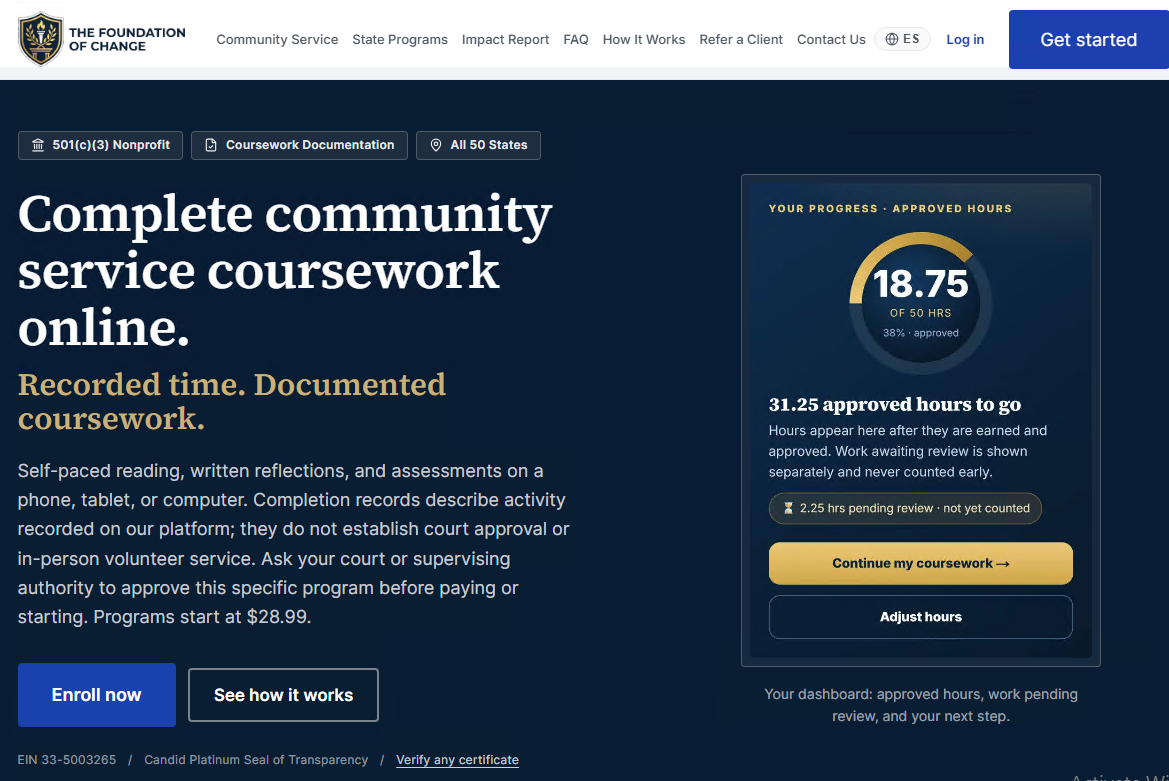
Its online system allows participants to select a required number of community-service hours, use an online platform, pay a fee and obtain documentation representing that community service was completed. A complaint concerning the organization alleges that the process can result in certificates and hour logs even when the underlying records show little or no substantive activity.
The issue is not simply that the program charges money. Nonprofits can legitimately charge administrative or program fees.
The more important question is what a participant must actually do before the organization certifies that community service was performed.
The More Hours You Need, the More You Pay
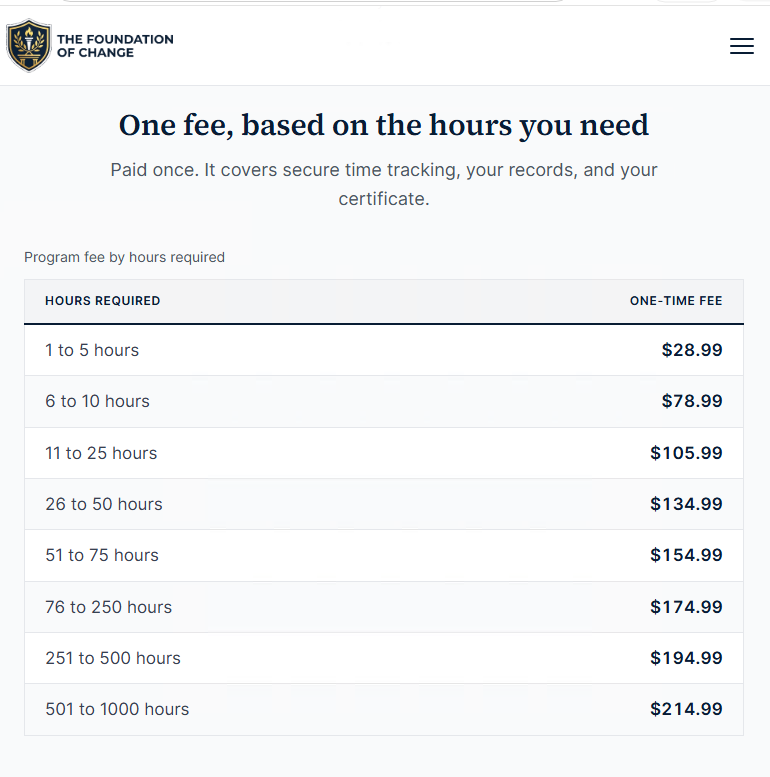
Materials preserved with the complaint describe a pricing structure tied to the number of community-service hours selected by the participant.
The complaint alleges that after the selected time requirement is reached and the applicable fee is paid, the platform can generate documentation representing that the participant completed verified community service.
That creates an unusual relationship between money, time and proof of service.

A participant isn't merely purchasing an educational course with a fixed price. The service requirement itself is measured in hours, and the resulting documentation is intended to establish that those hours were completed.
For someone who needs proof of community service for a court or probation department, that document can be the entire point of enrolling.
Five Verified Hours — With No Articles or Reflections
Records cited in the complaint provide a particularly stark example.
One Detailed Activity Report records five verified hours for a participant while simultaneously reporting zero articles completed, zero reflections and zero final assessments.
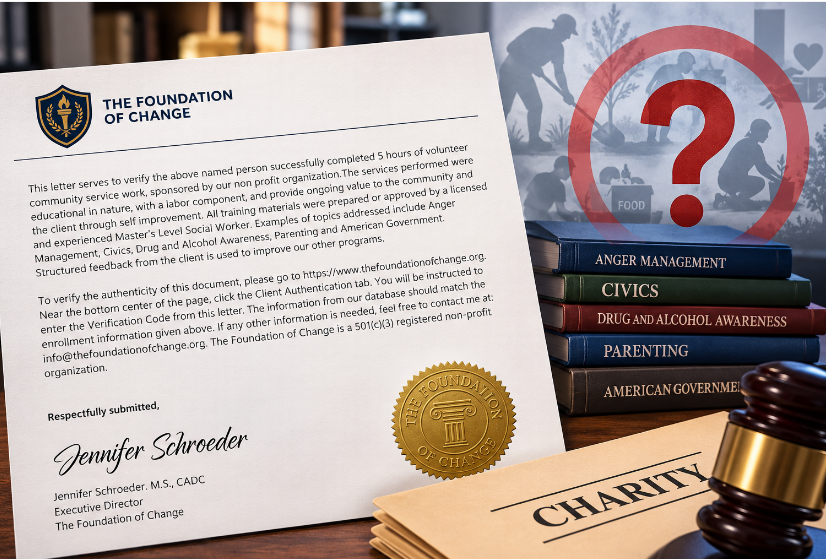
The corresponding paperwork nevertheless includes a completion statement representing five hours of structured educational community service. According to the complaint, that statement describes guided coursework with a labor component requiring written reflections for each module.
An associated hour log also records five completed hours.
View this video from 2026 showing that you can earn time with The Foundation of Change without having to do ANYTHING...
And here is a youtube video posted in 2025 that touts that you don't have to do ANY work:
Those documents create a basic discrepancy.
The completion paperwork describes structured service involving coursework and written reflections.
The activity record says none were completed.
Yet five hours were still recorded as verified.
What Was Being Purchased?
Charging a participant a fee does not, by itself, mean the participant purchased community-service hours.
That distinction is important.
The Foundation could maintain that participants are paying for access to its program, technology, administration and verification rather than purchasing the hours themselves.
But that explanation makes the underlying activity records especially significant.
If payment is merely an administrative component of a legitimate service program, there should still be identifiable service or required activity underlying the hours that are ultimately certified.
The records cited in the complaint raise questions about what that activity was.
A continuous screen recording designated Exhibit Y is described as documenting an ordinary participant using the platform without bypassing its controls or altering its code. According to the complaint, the participant could load the relevant webpage, perform no substantive charitable work and allow time credited toward the service requirement to continue accumulating.
The exhibit list identifies that evidence as a continuous recording of the ordinary participant workflow.
The Certificate Is What Matters Outside the Website
A timer running on a website has little significance by itself.
The stakes change when the accumulated time is converted into documentation that can be shown to someone else as proof that community service occurred.
That is precisely why the distinction between elapsed time and performed service matters.
The complaint says The Foundation of Change has publicly represented that its platform uses safeguards designed to ensure that credited time represents genuine participation. Those representations reportedly include inactivity monitoring, an AFK timeout, required reflections, engagement controls and server-side tracking.
If those safeguards operate as represented, the organization could potentially distinguish actual participation from someone simply waiting for time to pass.
The preserved participant records and recorded test raise questions about whether that distinction was actually being made.
Selling a Program Is Not the Same as Selling Hours
There is an important line here.
An organization can charge $100 for a program in which someone actually performs 20 hours of legitimate service. The existence of a fee does not erase the work.
But if someone can pay for a program, allow a timer to accumulate the required time without performing the represented work, and then receive documentation stating that the service was completed, the transaction begins to look fundamentally different.
The complaint expressly characterizes the Foundation as a private fee-generating certificate operation and asks regulators to investigate whether its nonprofit structure and tax-exempt status have been used to lend institutional legitimacy to that operation. That remains an allegation, not a judicial finding.
The underlying evidence is what makes the allegation capable of being tested.
Investigators could compare payment records, participant activity, server logs, reflections, completed assignments, recorded time and certificate issuance for individual accounts.
For every certificate, there should be a straightforward answer to a straightforward question:
What community service did this person actually perform?
When money changes hands and a document subsequently certifies hours of community service, that answer matters far more than how sophisticated the certificate looks.