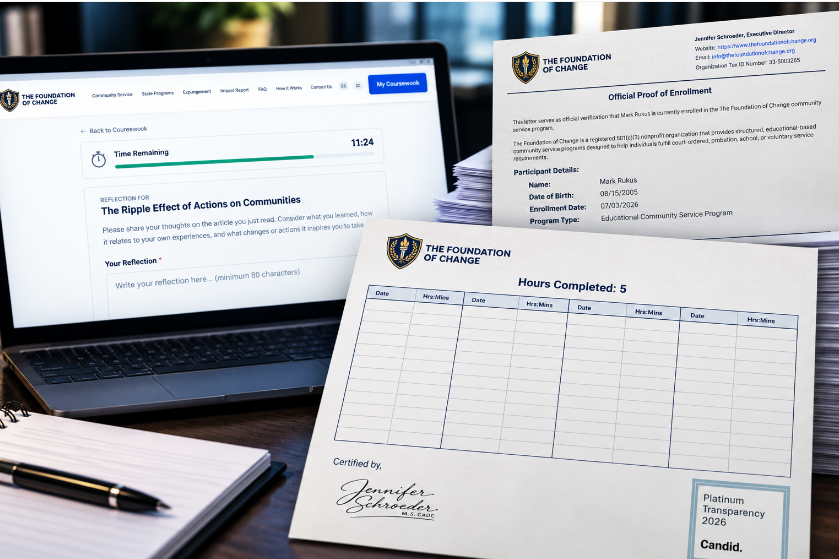
 A community-service certificate carries an important implication.
Someone performed the work, and someone else verified that it happened.
With The Foundation of Change's online community-service program, however, evidence submitted in a regulatory complaint raises questions about what that verification actually means.
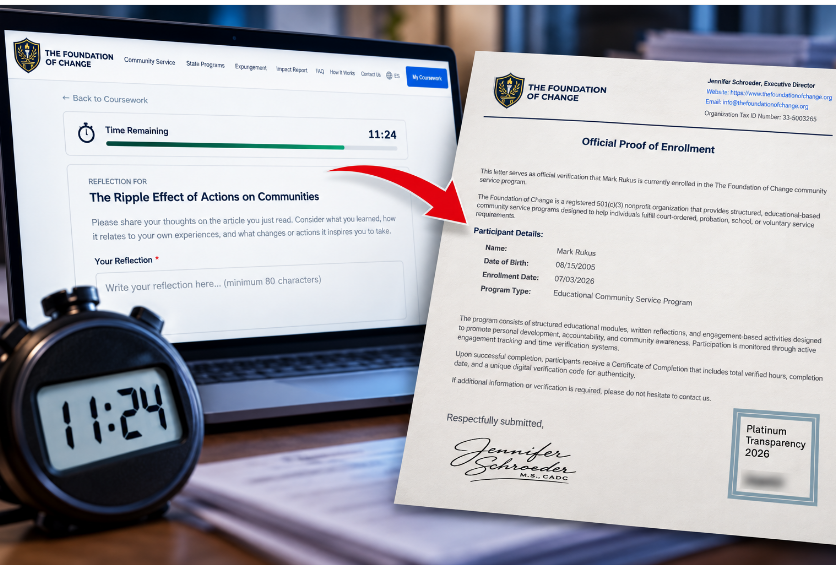
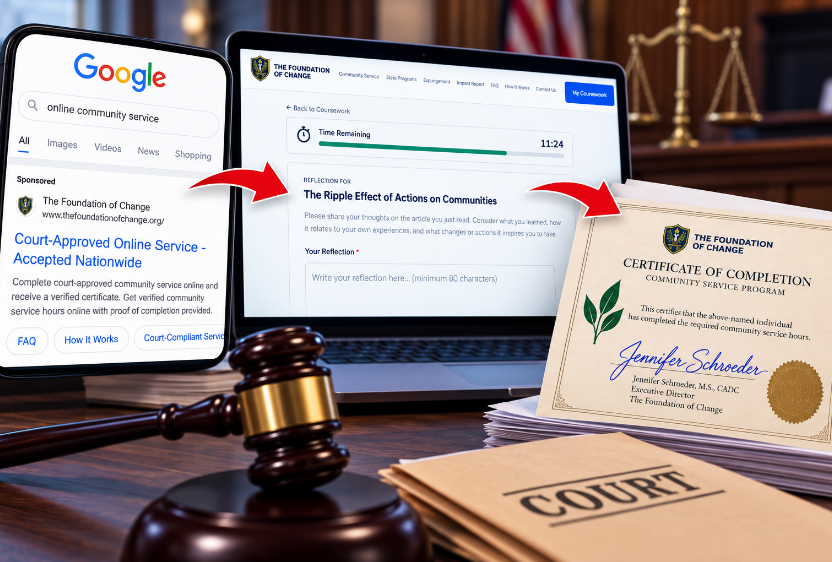
The Foundation promotes a technology-driven system that tracks participants online and ultimately produces documentation representing completed community-service hours. Its materials describe server-side tracking, activity monitoring, written reflections and other safeguards intended to establish that the hours were genuinely earned.
But when the underlying participant records are examined, the relationship between a generated certificate and actual completed work becomes much less clear.
Five Hours Were Verified — But What Was Verified?
One participant record included with the complaint provides a particularly stark example.
The Foundation's Detailed Activity Report reportedly credited the participant with five verified hours.
At the same time, the report showed:
0 articles completed
0 reflections
0 final assessments
The report itself stated that the five verified hours were completed across zero articles and zero final assessments.
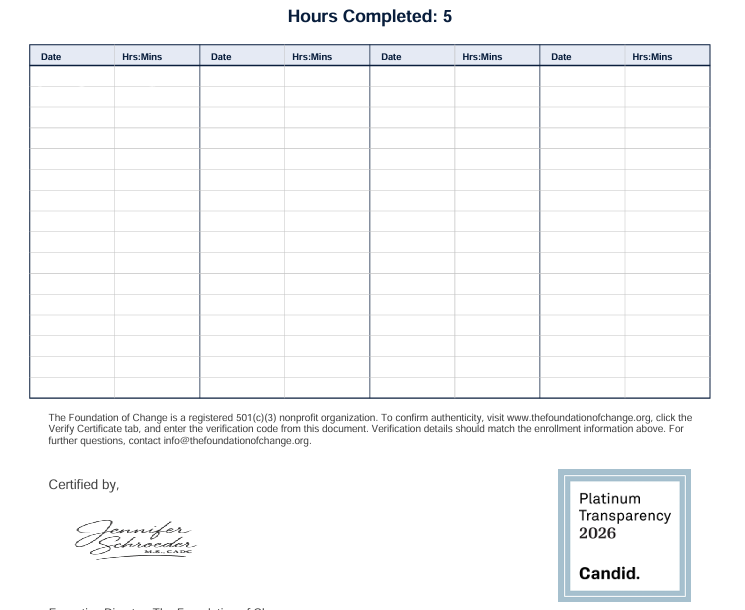
Yet the corresponding completion statement represented that the participant completed five hours of structured educational community service.
According to the complaint, that document also described a labor component requiring written reflections for the modules. A separate hour log recorded five hours of completed service.
That creates an obvious verification question.
If no reflections were completed, what verified the claimed reflection work?
If no articles or final assessments were completed, what activity supported the five hours?
And who—or what—ultimately determined that those hours constituted completed community service?
Verification Appears to Depend Heavily on Software
The Foundation's own descriptions place considerable emphasis on technology.
Its materials reportedly claim that participants cannot simply leave a webpage open and accumulate hours. The organization describes active-participation requirements, inactivity monitoring, an AFK timeout, restrictions on simultaneous coursework and other mechanisms designed to ensure the integrity of recorded time.
In other words, much of the verification appears to depend upon the platform correctly distinguishing active service from passive elapsed time.
That makes evidence about the operation of the software particularly important.
A continuous screen recording submitted with the complaint allegedly demonstrates that an ordinary participant could allow time to continue accruing without performing substantive charitable work. According to the complaint, no controls were bypassed and no website code was altered during the test.
If that account is accurate, a timer can record time without necessarily establishing that the corresponding service was performed.
A Verification Number Does Not Answer the Question
The Foundation also provides verification mechanisms associated with its documentation.
Those mechanisms can establish that a particular document exists in the organization's system.
But that is different from independently establishing that the work described by the document occurred.
The distinction becomes clearer in another set of participant records identified in the complaint.
For a second participant, two Foundation service logs reportedly carried the same participant identity, date, court identifier and verification code—but reflected dramatically different amounts of time.
One showed 4 hours and 41 minutes.
Another showed 2 minutes.
A separate completion statement represented five hours of volunteer community-service work.
If the same verification information can be associated with conflicting time records, the existence of a verification code alone does not resolve which underlying record accurately reflects what happened.
Verification of a Document Is Not Verification of Work
This is the distinction that courts and probation officials may need to consider when evaluating these records.
A computer can verify that a certificate number exists.
A database can verify that an account accumulated five hours.
A server can verify that a timer was running.
And software can automatically generate a document from those records.
None of those things necessarily establishes that a human being actually performed five hours of community service.
The Foundation itself makes the reliability of its technological safeguards central to its representations. Its materials say the system maintains exact server-side records and provides audit-ready time histories, while its Terms and FAQ reportedly require completion of coursework and reflections and state that idleness is actively monitored.
That is why the discrepancies in the participant records matter.
Who Signed Off on the Actual Work?
The complaint asks regulators to examine the Foundation's underlying software, database, certificate records and verification controls rather than simply accepting the resulting paperwork at face value.
That examination could answer a fundamental question:
Who actually determined that the participant performed the work described on the certificate?
The available records show a system capable of recording time and producing verification documents. They also show at least one participant credited with five verified hours despite zero completed articles, reflections and final assessments, while a recorded test allegedly demonstrates that time could accumulate without substantive charitable work.
Those facts do not establish what occurred in every participant account. That would require examination of the underlying records.
But they expose an important distinction.
A computer can verify that it generated a certificate. That does not necessarily mean anyone verified that the work printed on the certificate was actually performed.