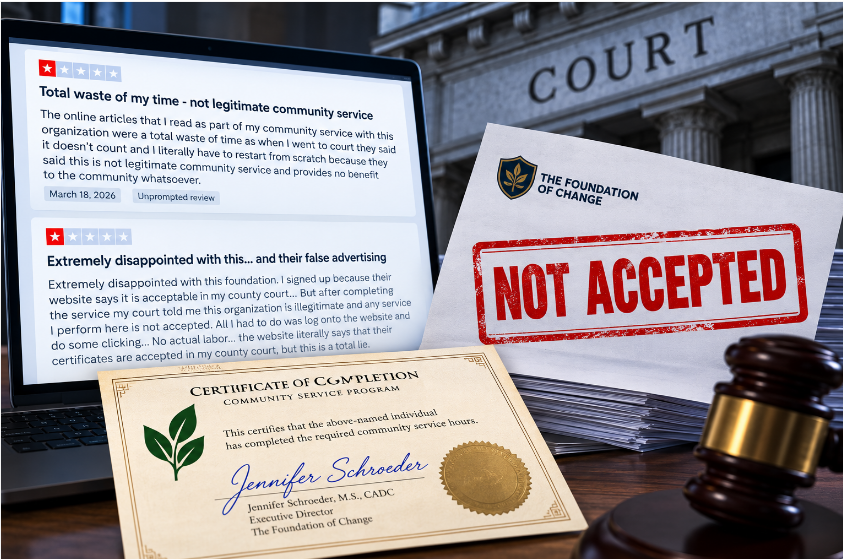
 For someone ordered by a judge to perform community service, few words in an advertisement could be more reassuring than “Court-Approved.”
The Foundation of Change has used precisely that language.
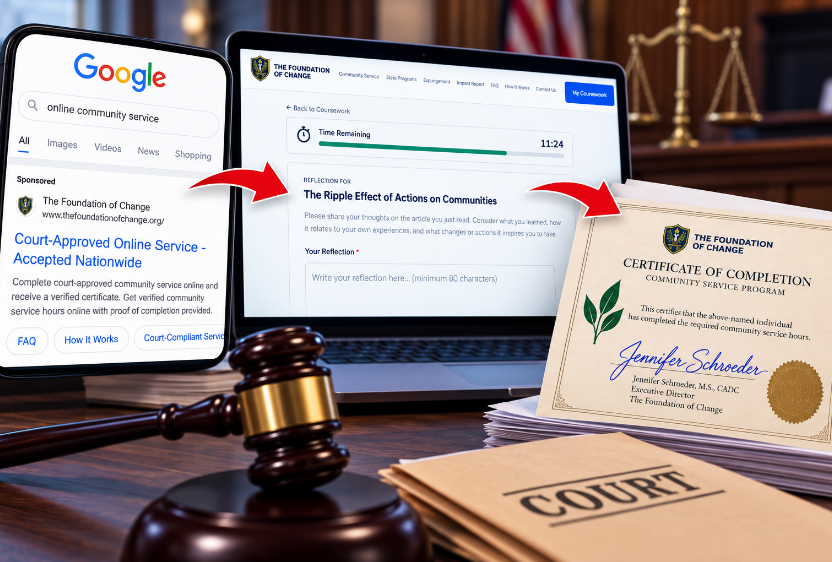
Evidence compiled in a regulatory complaint shows paid Google advertisements promoting the organization's program as “Court-Approved Online Service” and “Court-Approved Service Hours.” Preserved state-specific webpages went further, displaying “Court-Approved” and “Probation-Compliant” badges while making sweeping claims about acceptance by courts and probation departments.
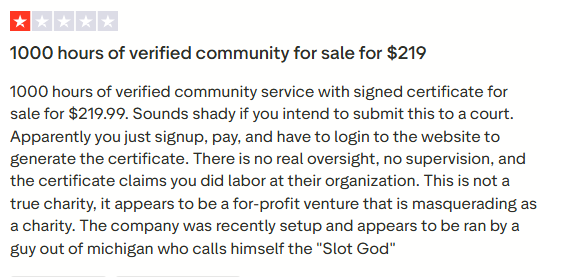
But preserved consumer reviews describe something very different.
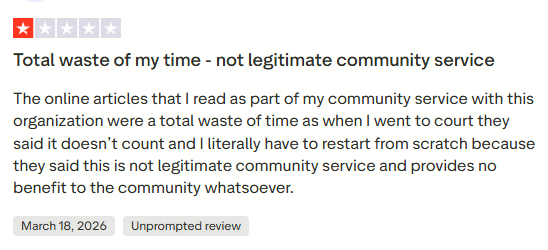
According to the complaint, customers have reported purchasing the program believing it would satisfy their court requirements, only to have their hours or certificates rejected.
“Accepted Across All 58 Counties”
The Foundation's California marketing illustrates just how specific the representations became.
According to preserved webpages cited in the complaint, The Foundation of Change described itself as a nonprofit “accepted by California courts and probation departments.”
The California page reportedly stated “Accepted Across All 58 Counties” and displayed badges reading “Court-Approved,” “Probation-Compliant” and “California Accepted.”
It also represented that the program was accepted by California Superior Courts throughout all 58 counties, while metadata associated with the page claimed the program was accepted in all 50 states.
California wasn't alone.
The Foundation's Florida page reportedly represented acceptance by all Florida courts and probation departments and described the program as “Trusted Across All 67 Counties.”
Its Nevada page similarly represented acceptance by courts, probation officers and schools throughout the state's 17 counties.
Those aren't vague statements that online community service might be accepted.
They convey something much stronger.
The Fine Print Tells a Different Story
One of the most revealing contradictions appears on the Foundation's own Nevada material.
According to the complaint, the page makes broad representations that the program is accepted by Nevada courts and throughout all 17 counties.
But an FAQ on the same page reportedly retreats from that categorical language, stating instead that “many” Nevada courts accept online community service and recommending that participants confirm acceptance with their particular court.
Those are materially different messages.
“Court-Approved” suggests approval has already been established.
“Accepted across all 17 counties” suggests statewide acceptance.
“Check with your specific court” acknowledges that acceptance may depend upon the individual court.
For a person facing a court deadline, that distinction can determine whether dozens—or hundreds—of claimed service hours actually satisfy an order.
Then Come the Rejections
The regulatory complaint also preserves consumer reports describing the exact problem that such broad acceptance claims could create.
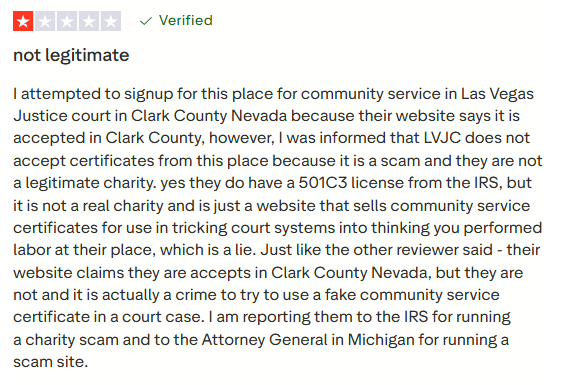
Trustpilot reviews cited in the complaint reportedly include customers who said they enrolled because they believed The Foundation of Change would satisfy their court requirements, only to have their certificates or hours rejected.
One reviewer reported being told by a court that the activity “doesn't count” and that the service hours had to be restarted.
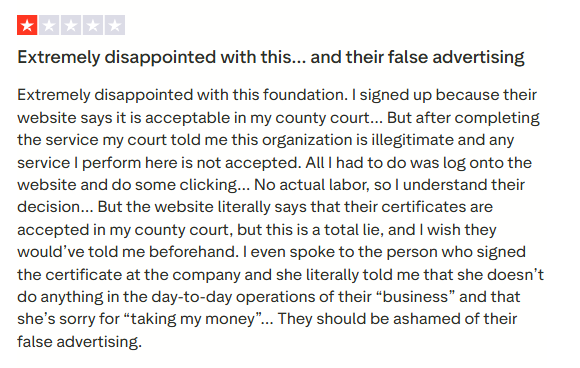
Another reportedly said the Foundation's website represented that its program was accepted in the customer's county, but the court rejected it.
A verified Trustpilot review concerning Clark County, Nevada also disputed the Foundation's representations about acceptance.
Preserved Yelp reviews contain similar allegations, including reports that certificates advertised as court approved were rejected.
These reviews are consumer allegations, not judicial findings, and should not by themselves be treated as proof that every acceptance representation was false.
But they raise an obvious question that can be independently answered:
Which courts actually approved the program?
Where Are the Approvals?
That question becomes particularly important because the Foundation wasn't merely relying on word of mouth.
The complaint identifies paid Google advertisements expressly promoting “Court-Approved Online Service” and “Court-Approved Service Hours,” along with state and county webpages designed to reach people searching for court-approved community service in particular jurisdictions.
If a program claims acceptance across every county in a state, the claim should be capable of verification.
There should be some basis for saying so.
The complaint therefore asks investigators to require The Foundation of Change to identify the courts that supposedly approved its program and produce documentation supporting those representations.
That would provide a straightforward way to resolve the issue.
“Court-Approved” Should Mean Something
None of this means that every Foundation of Change certificate has been rejected.
The evidence reviewed by Activist Legal does not establish that.
Nor does a rejection by one court establish what another court will accept.
That is precisely why sweeping representations of court approval deserve scrutiny.
Individual judges, probation departments and jurisdictions can impose their own requirements. The Foundation's own disclaimer apparently recognizes this by advising participants to confirm acceptance with their specific court.
But that caution sits uneasily beside advertising proclaiming “Court-Approved” service, state pages representing acceptance across every county, and metadata claiming acceptance in all 50 states.
And preserved customer complaints show the potential consequence of getting that representation wrong: people who believed they had satisfied their obligations being told that their service did not count.
For someone completing court-ordered community service, “ask your court first” and “Court-Approved” are not the same promise.