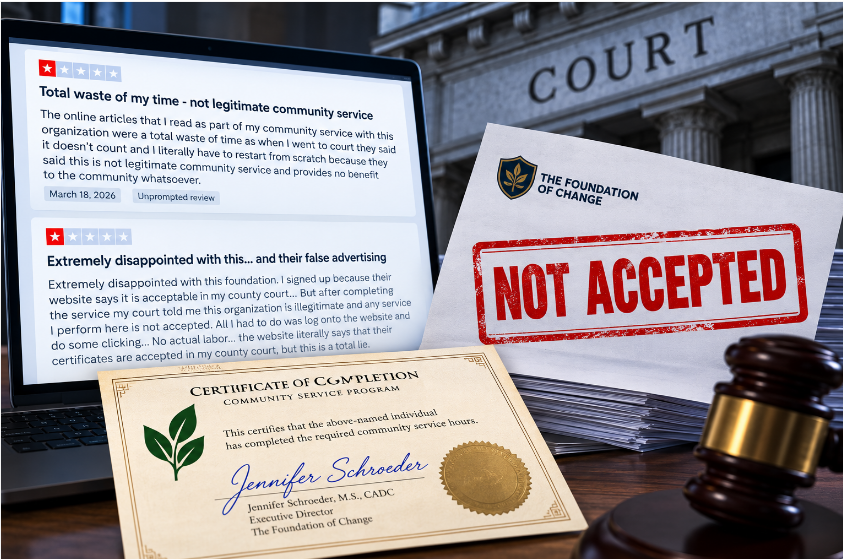
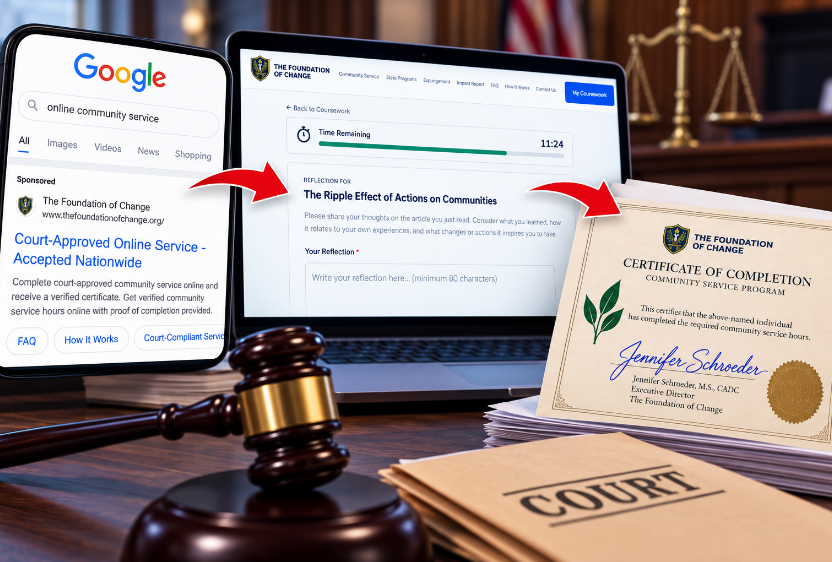
 The path from searching Google for court-ordered community service to obtaining a certificate from The Foundation of Change can be surprisingly short.
Evidence assembled in a regulatory complaint shows a business model built around people who need community-service hours for courts, probation departments and other institutions.
The process begins with marketing.
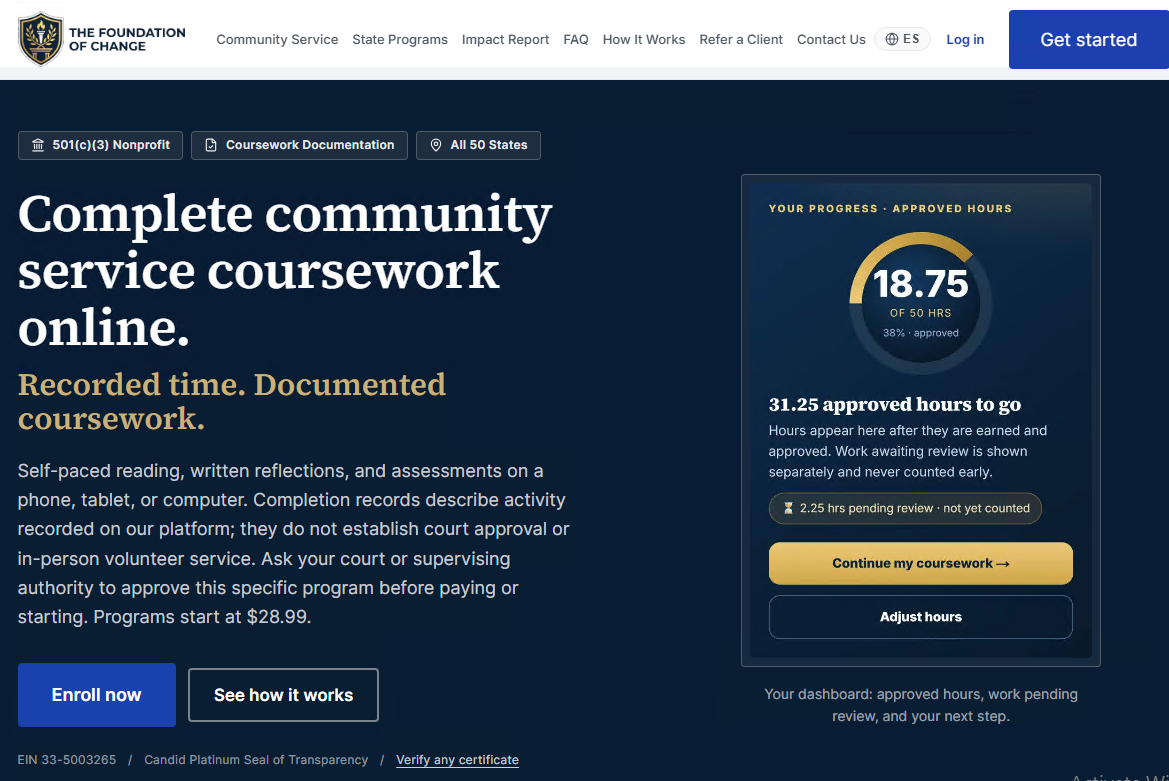
It moves to a website where participants select the number of hours they need and pay a fee.
Those hours are accumulated through an online platform.
And at the end is documentation that can be presented to a court or probation department as proof of completed community service.
The regulatory complaint describes the resulting product bluntly: documentation that converts elapsed website time into purported community-service credit for presentation to third parties.
Step One: Find Someone Who Needs Court-Ordered Service
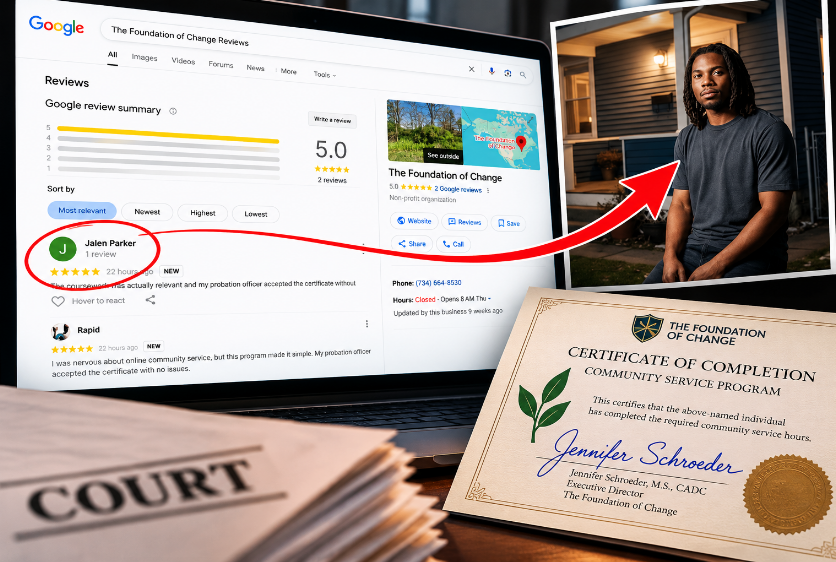
The Foundation has marketed directly to people searching for ways to satisfy community-service requirements.
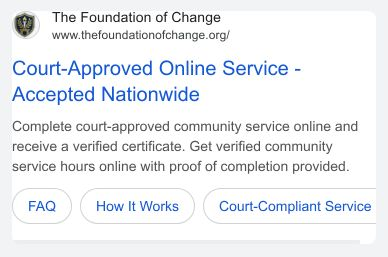
Preserved screenshots from Google's Ads Transparency Center show paid advertisements using phrases including:
“Court-Approved Online Service”
and
“Court-Approved Service Hours.”
The advertising is reinforced by geographically targeted webpages.
Preserved California, Florida and Nevada pages use state and county references along with “Court-Approved” and “Probation-Compliant” messaging. The California page reportedly claims acceptance across all 58 counties, while Florida marketing refers to all 67 counties and Nevada materials reference all 17 counties.
The strategy places The Foundation of Change directly in front of a particularly motivated customer: someone who has been told to complete a specific number of community-service hours and needs documentation proving it.
Step Two: Select the Number of Hours
Once someone reaches the Foundation, the number of required hours also determines the applicable fee tier.
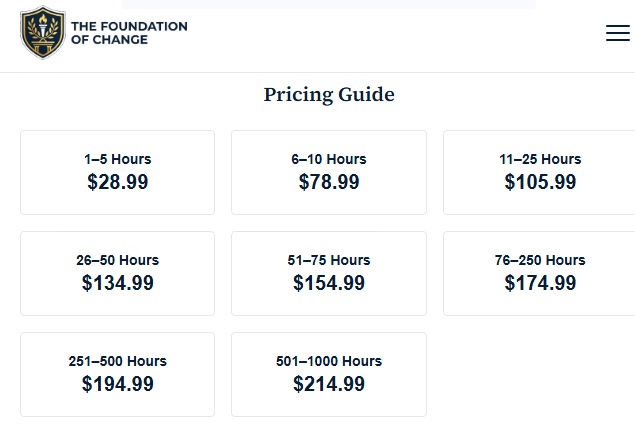
According to the pricing schedule preserved with the complaint:
1–5 hours: $28.99
6–10 hours: $78.99
11–25 hours: $105.99
26–50 hours: $134.99
51–75 hours: $154.99
76–250 hours: $174.99
251–500 hours: $194.99
501–1,000 hours: $214.99
The Foundation describes those fees as supporting features including verified time tracking, anti-fraud architecture, educational coursework, reflection prompts, secure recordkeeping and certificate issuance.
The structure nevertheless creates a direct commercial relationship between the participant's required number of community-service hours and the amount paid to access the program.
Step Three: Accumulate the Hours Online
The participant then uses the Foundation's online system.
The Foundation says this isn't simply a timer.
Its materials describe active-participation requirements, AFK detection, minimum engagement periods, written reflections and other safeguards intended to ensure that every certified minute was genuinely earned.
But evidence submitted with the regulatory complaint challenges how those safeguards function in practice.
A continuously recorded ordinary-user test allegedly shows that time can continue accumulating toward a service requirement without substantive charitable work being performed. According to the complaint, the test did not involve altering the website's code or bypassing its controls.
The Foundation's own participant records raise the same concern.
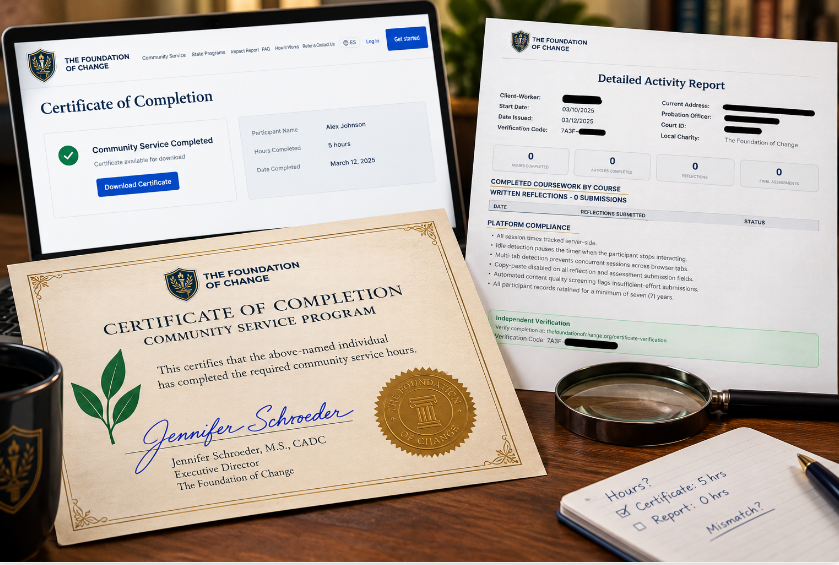
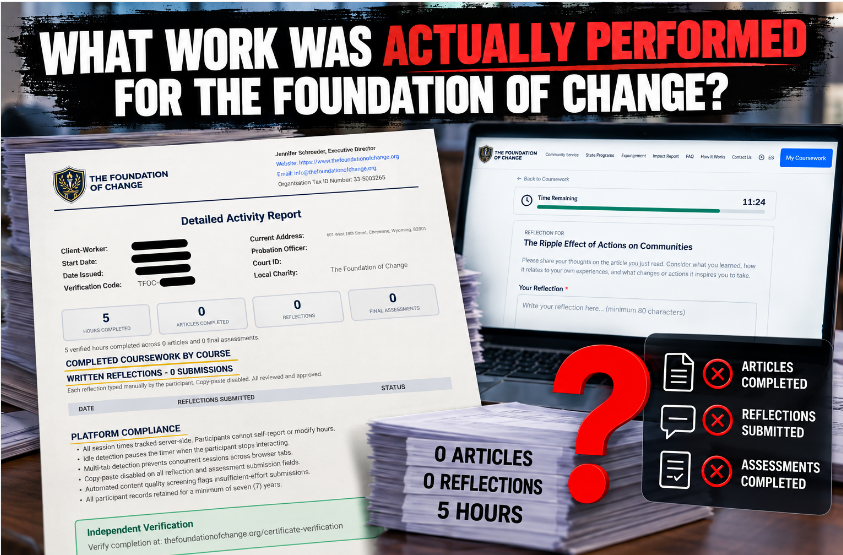
One Detailed Activity Report reportedly credited a participant with five verified hours while simultaneously recording zero articles completed, zero reflections and zero final assessments.
Step Four: Turn the Hours Into Documentation
This is where the model becomes particularly important.
The hours aren't valuable merely because they exist inside a website database.
Their value comes from the documentation generated from them.
For the participant whose activity report showed five hours with no completed articles, reflections or assessments, the Foundation nevertheless produced a corresponding completion statement representing five hours of structured educational community service.
A separate hour log also recorded five completed hours.
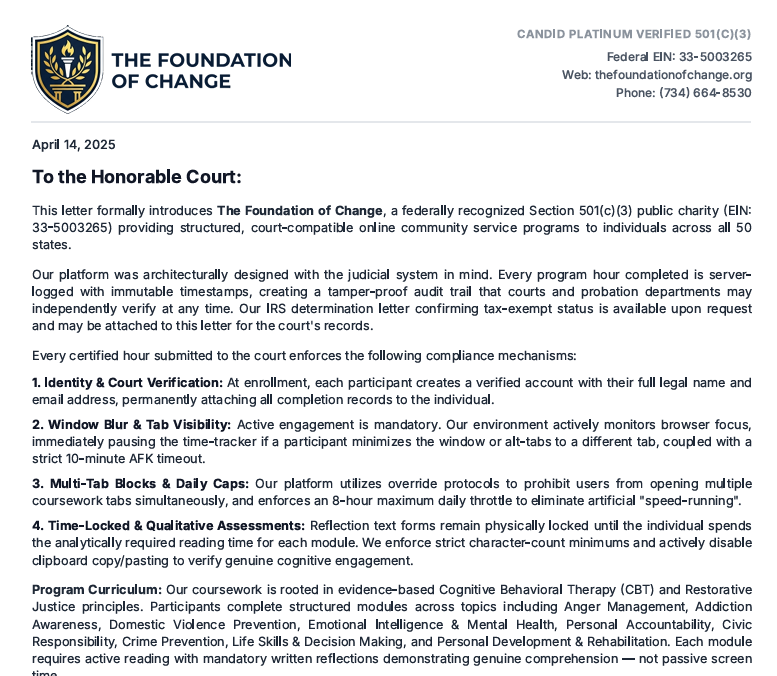
The Foundation's institutional materials are specifically directed toward courts and probation departments and describe verifiable service hours, court-ready documentation and independent verification.
In other words, the process doesn't end when the timer stops.
It ends when the recorded time becomes documentation capable of being handed to someone responsible for determining whether a legal obligation was satisfied.
Step Five: Present the Certificate to the Court
The complaint identifies records associated with hundreds of participants who received Foundation completion certificates.
Those records reportedly include participant identities, hour totals, amounts paid, certificate numbers and issuance dates. The complaint says the certificate information allows investigators to trace individual documents backward through payment, timer and activity records and forward to the judicial proceedings where the certificates were presented.
That creates an unusually clear chain for investigators to examine:
Advertisement → enrollment → payment → timer → certificate → court.
Each stage leaves records.
Google can establish what advertisements were displayed.
Payment records can establish what participants paid.
Server logs can establish what happened inside their accounts.
Activity reports can establish what coursework was actually completed.
Certificate records can establish what the Foundation represented.
And court files can establish what documents were ultimately submitted.
The Certificate Is the Product That Makes the System Valuable
The Foundation describes itself as a nonprofit community-service organization, and the existence of fees does not by itself establish anything improper. Nonprofits can charge fees for programs and services.
The more significant issue raised by the complaint is what participants receive in exchange for those fees and whether the resulting documents accurately represent what occurred.
A person with a court order doesn't need a timer for its own sake.
They need something a court will recognize as proof that the required service was completed.
That makes the certificate—and the credibility attached to it—central to the economic value of the program.
The regulatory complaint argues that representations concerning court acceptance, verification, active participation and the authenticity of the hours therefore go directly to the value of what the Foundation offers.
Regulators have not yet established the ultimate conclusions alleged in the complaint. Determining the full picture would require examination of the Foundation's financial records, software, participant activity, advertising accounts and certificate history.
But the documented structure of the operation is already visible.
A person searches for court-approved community service.
They encounter advertising emphasizing court approval.
They select an hour requirement and pay the corresponding fee.
A website records the hours.
Software produces the documentation.
And that documentation can ultimately enter a courtroom as purported proof of completed service.
From Google ad to court certificate, the critical question remains the same: what actual community service occurred between the two?