Traditional community service is easy to understand.
A person reports to a nonprofit, performs unpaid work, and someone at the organization verifies the hours that were actually worked.
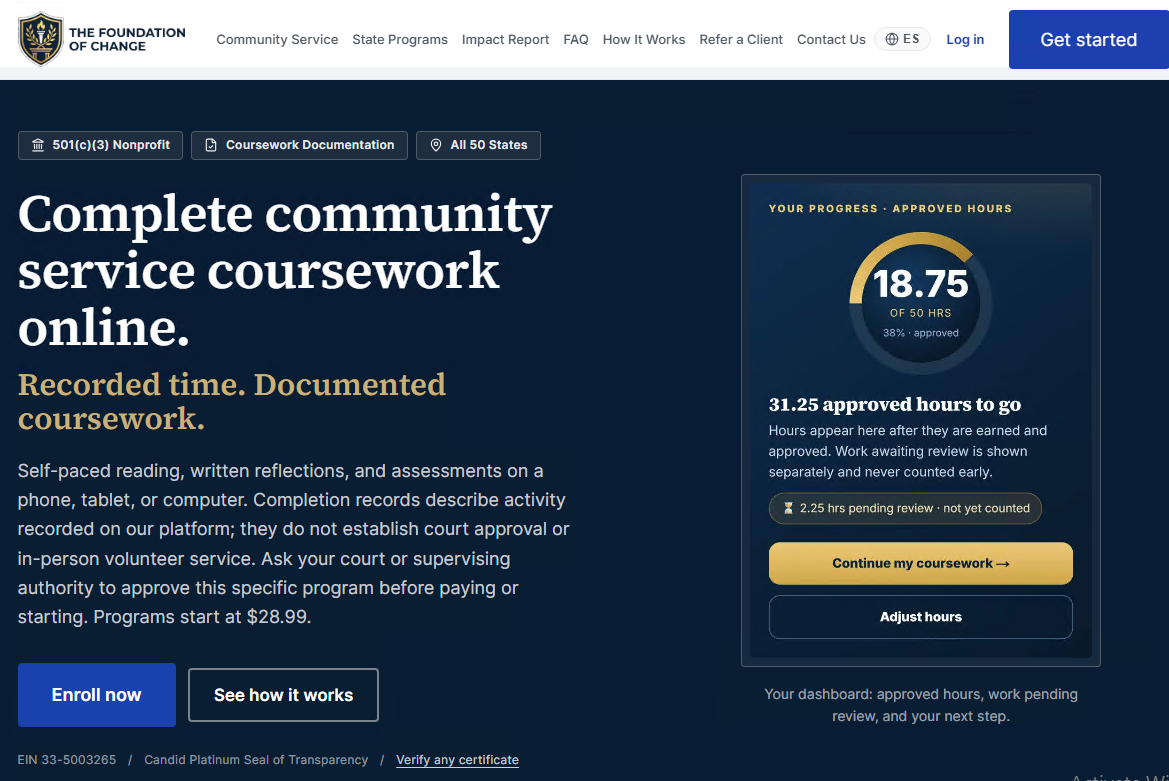
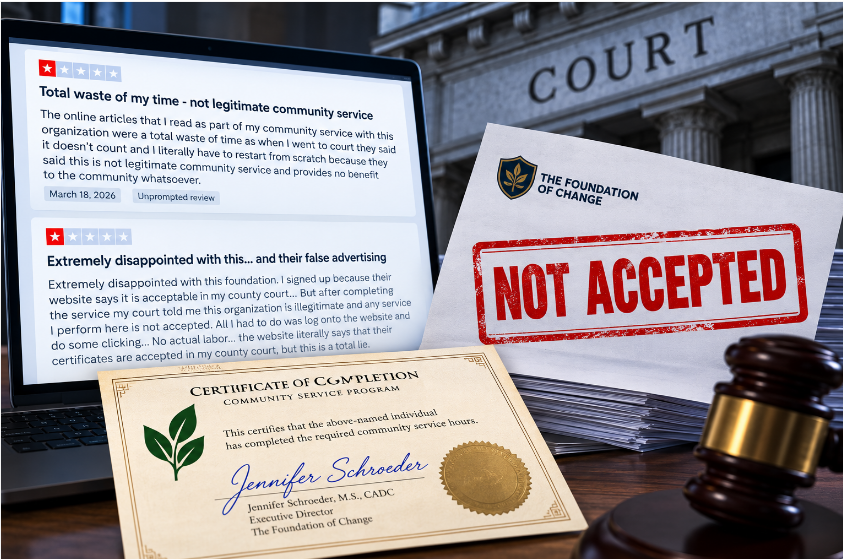
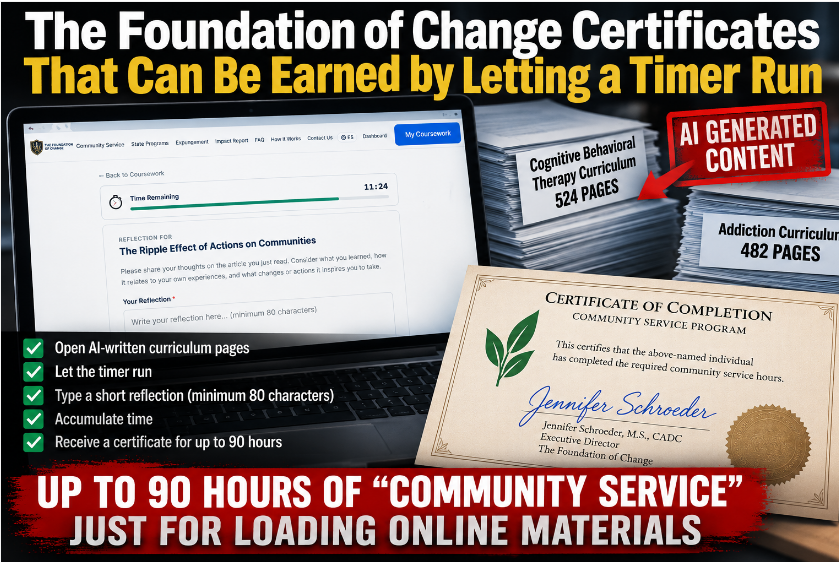
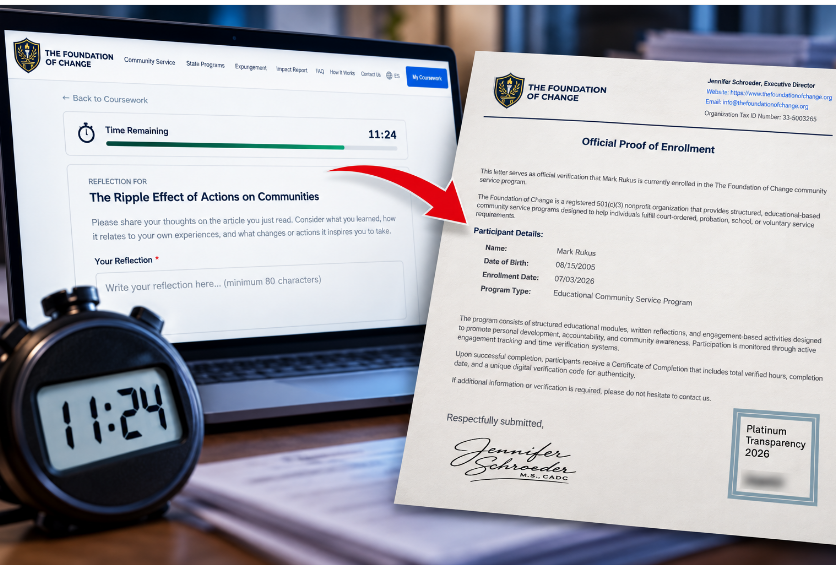
The Foundation of Change offers something very different: an online system in which participants accumulate community-service hours through a website and can ultimately receive documentation intended to verify completion.
The organization says those hours are protected by sophisticated safeguards designed to ensure participants are actively engaged.
But evidence submitted in a regulatory complaint raises a troubling question about what the system is actually measuring.
Is it measuring community service—or simply measuring a running clock?
The Clock Is Central to the System
The Foundation of Change has represented that its online platform does not operate on an honor system.
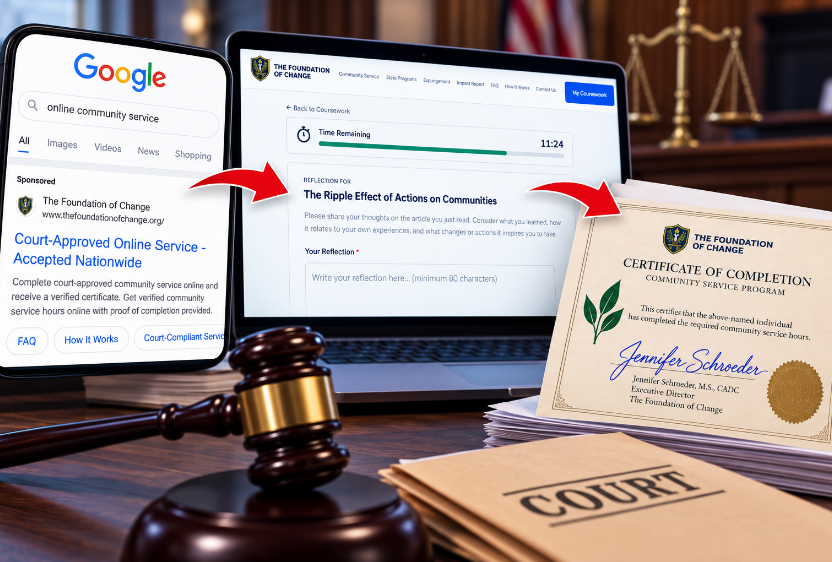
According to preserved Foundation materials described in the complaint, the organization says its system requires active participation and uses multiple technological controls to ensure that every minute represented on a certificate was genuinely earned.
Those claimed controls include an inactivity system, an AFK timeout, restrictions on simultaneous coursework, minimum reading periods and written reflections. The Foundation also says the timer pauses when a participant minimizes the browser or changes windows.
Those are unusually important promises for this particular program.
The Foundation sells access based partly on the number of community-service hours a participant needs. Its preserved pricing schedule ranges from $28.99 for one to five hours to $214.99 for 501 to 1,000 hours.
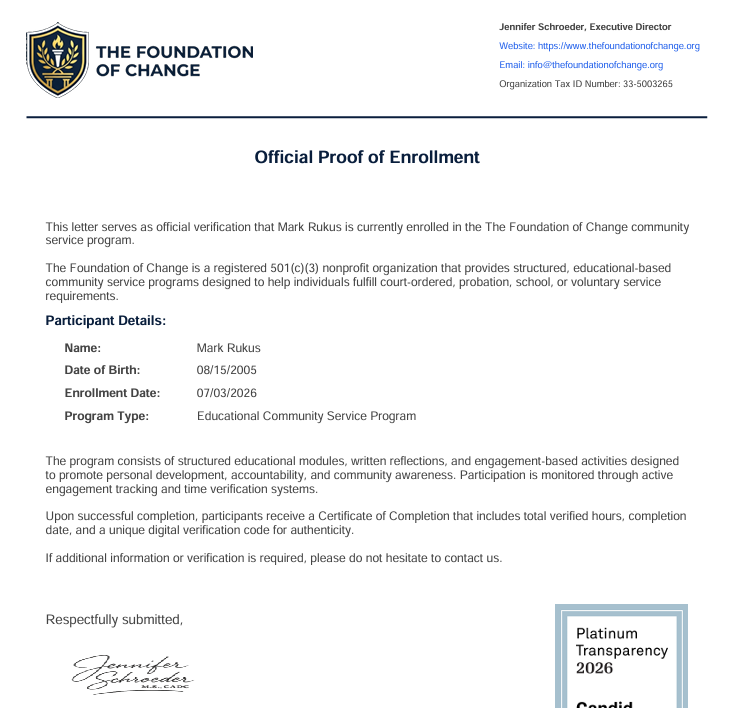
The hours ultimately become the basis for documentation that can be presented to a court, probation department, school or other institution.
What a Recorded Test Found
A continuous screen recording submitted as part of the complaint documented the platform from the perspective of an ordinary participant.
According to the complaint, the person conducting the test did not manipulate the website, alter its code or circumvent its controls.
Instead, the participant simply used the system available to an ordinary account.
View this video from 2026 showing that you can earn time with The Foundation of Change without having to do ANYTHING...
And here is a youtube video posted in 2025 that touts that you don't have to do ANY work:
The complaint says the recording demonstrates that a user can load the relevant page and allow time to continue accruing toward the service requirement without performing substantive charitable work.
That finding goes directly to the purpose of the Foundation's advertised safeguards.
An AFK detector matters only if it actually prevents inactive time from becoming service time. Activity monitoring matters only if the activity is required before hours are credited.
If the clock continues accumulating credit without meaningful activity, the sophisticated terminology surrounding the system does not change what is happening underneath it.
Time is passing.
And that time is becoming community-service credit.
The Foundation's Own Records Raise the Same Question
The recorded test is not the only evidence raising concerns about the timer.
One participant's own Foundation-generated Detailed Activity Report reportedly showed five verified hours.
But the same report recorded:
0 articles completed.
0 reflections completed.
0 final assessments completed.
According to the complaint, the report expressly states that five verified hours were completed across zero articles and zero final assessments.
Nevertheless, the participant's corresponding completion statement represented that five hours of structured educational community service had been completed and described a labor component involving written reflections.
A separate hour log also recorded five completed hours.
The records therefore present a simple question that does not require any technical expertise:
What happened during those five hours?
If there were no completed articles, no reflections and no final assessments, what activity transformed five hours of elapsed time into five hours of verified community service?
Why the Timer Matters to Courts
The issue would be considerably less consequential if the website were simply an educational platform where users tracked their own study time.
It isn't marketed that way.
The Foundation's materials specifically contemplate its documentation being provided to courts and probation departments. The complaint says the organization's institutional materials describe verifiable service hours, court-ready documentation and independent verification.
The Foundation has also advertised what it calls “Court-Approved Online Service” and “Court-Approved Service Hours.”
That makes the integrity of the underlying clock critical.
A probation officer looking at a five-hour service document may reasonably believe that the five hours correspond to five hours of the activities the organization says it requires.
The participant records described in the complaint raise doubts about that assumption.
From Elapsed Time to an Official-Looking Document
Computers are very good at measuring elapsed time.
They are also very good at generating documents.
Neither capability establishes that community service actually occurred.
The regulatory complaint argues that this distinction is at the heart of The Foundation of Change's operation: the revenue-producing product is documentation that can convert elapsed website time into purported community-service credit for presentation to third parties.
Whether regulators ultimately agree with that characterization remains to be determined.
But the evidence identified in the complaint presents a discrepancy that deserves an explanation.
The Foundation says its safeguards ensure that every certified minute is genuinely earned.
A continuously recorded participant test allegedly shows time accruing without substantive charitable work.
And a Foundation-generated activity report shows five verified hours alongside zero completed articles, zero reflections and zero final assessments.
The technology may be complicated.
The question it raises is not: When the clock is running, what community service is actually being performed?