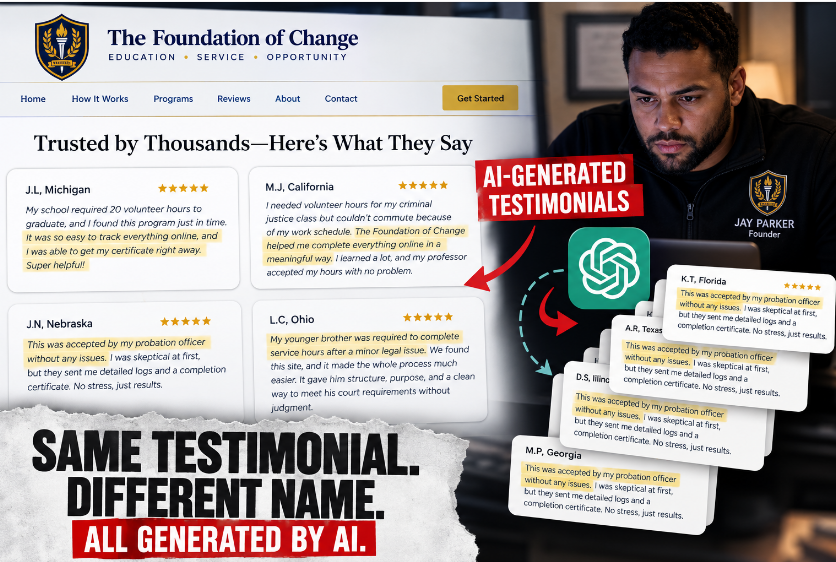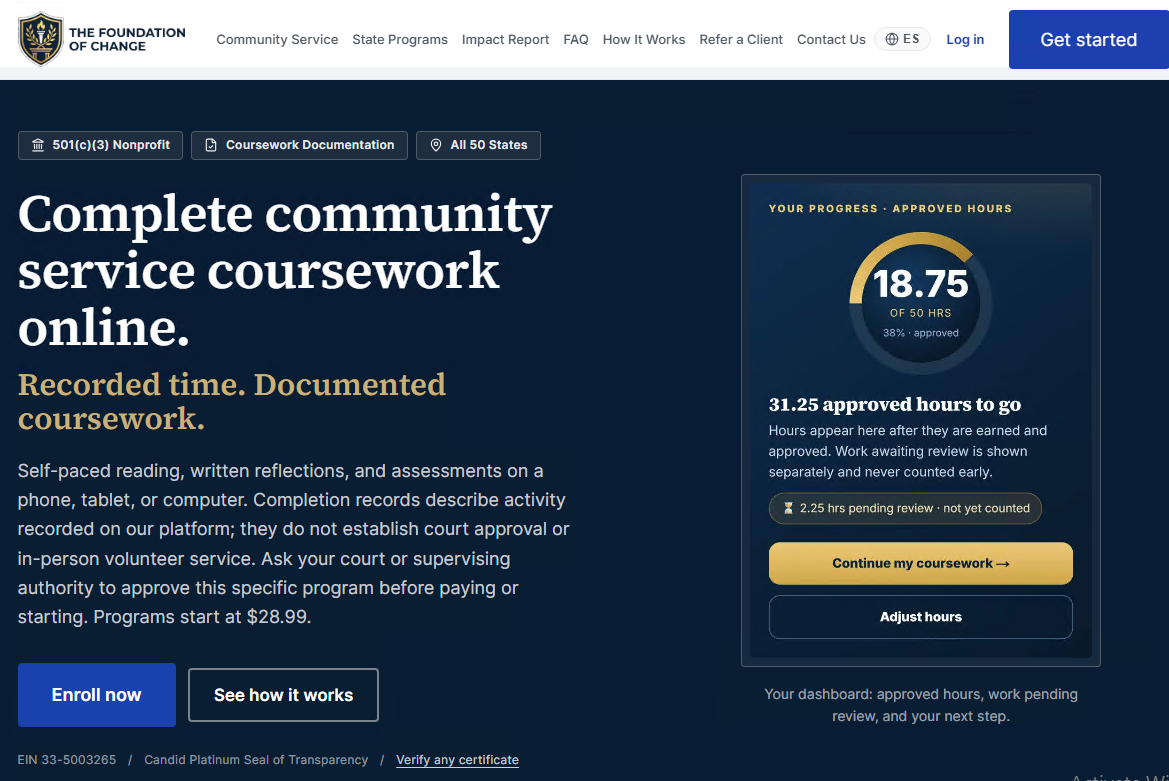

The deeper you look into The Foundation of Change's online community-service program, the stranger its enormous behavioral-health curriculum becomes.
Participants are presented with hundreds upon hundreds of pages covering Cognitive Behavioral Therapy, addiction, trauma, emotional regulation, neuroscience and other subjects normally associated with behavioral-health education or treatment.
The materials repeatedly invoke clinical research. They explain how participants' brains supposedly function, discuss psychological disorders and addiction, describe treatment methods and instruct participants in behavioral techniques.
And participants can receive what The Foundation of Change represents as community-service hours for spending time with these materials online.
But Activist Legal's review raises a more serious question:
Who actually wrote, reviewed and approved all of this?
The materials exhibit numerous characteristics consistent with mass-produced AI-generated text. At the same time, The Foundation of Change places the name and professional credentials of Executive Director Jennifer Schroeder, M.S., CADC on documents associated with the program.
The apparent message is one of professional oversight.
The evidence reviewed by Activist Legal raises questions about whether the reality matches that appearance.
Hundreds of Pages of Apparent AI-Generated Behavioral-Health Material
The scale alone is remarkable.
One CBT collection reviewed by Activist Legal contains hundreds of pages. The separate addiction curriculum provided to Activist Legal is 482 pages.
And these aren't simply articles saying drugs are dangerous or encouraging people to make better decisions.
They contain medical, neurological and psychological assertions.
The addiction material, for example, tells participants that chronic substance use reduces activity and volume in the prefrontal cortex and says that in some cases its functioning can be comparable to that of patients with traumatic brain injuries. It then tells readers that the part of their brain needed to quit is the very part being damaged by the substance.
Elsewhere, it describes withdrawal as a “neurological emergency.”
It discusses potentially fatal withdrawal, brain chemistry and the neurological effects of alcohol, opioids, stimulants, cannabis and nicotine.
The curriculum even discusses specific medications, including buprenorphine, methadone, naltrexone and acamprosate, while explaining treatment approaches for addiction.
The document does include a disclaimer stating that the course is not a substitute for medical treatment or professional counseling.
But a disclaimer doesn't answer the larger question:
Who professionally reviewed the material before it was put in front of participants?
The Signs of Machine-Generated Material Are Hard to Miss
Some portions read less like carefully edited clinical curriculum and more like text produced from a reusable template.
One section begins by repeating essentially the same heading three times:
“Behavioral Addictions: Beyond Substances”
“Behavioral Addictions: Beyond Substances”
“Understanding Behavioral Addictions: Beyond Substances”
It then launches into generic language promising a “comprehensive exploration” of the subject.
Hundreds of pages later, the same pattern appears with other topics.
“Risk Factors for Developing Addiction” is likewise repeated before another formulaic introduction begins.
Some of the resulting language is particularly questionable.
One section tells participants they can develop “skills in neuroplasticity” and that “proficiency in neuroplasticity improves with consistent practice.”
Another tells participants that by developing “competency in medication-assisted treatment,” they can create a stronger foundation for lasting change.
These aren't merely typographical errors. They illustrate why human professional review matters when automated systems are used to generate enormous quantities of material about psychology, addiction and treatment.
Then There Is Jennifer Schroeder
The Foundation's documents identify Jennifer Schroeder as its Executive Director and place her professional credentials on program documentation.
Her name appears beneath the words “Certified by” on service records reviewed by Activist Legal.
That matters because the Foundation isn't simply publishing an anonymous blog about mental health.
It is presenting behavioral-health material to participants while using that participation to generate records representing completed community-service hours.
The presence of a credentialed professional's name naturally raises an important question:
Did that professional actually review the curriculum?
That question becomes considerably more important in light of a recorded telephone conversation with Schroeder obtained by Activist Legal.
In that conversation, Schroeder says she is not involved in the organization's day-to-day operations and directs questions concerning payments and the operation of the program to “Jay.”
The recording is published with Activist Legal's reporting so readers can hear her statements directly.
That creates an obvious tension.
If Schroeder isn't involved in the Foundation's day-to-day operations, what exactly is her role in reviewing the enormous volume of behavioral-health material being provided to participants?
Does she review every article?
Does she verify its medical and psychological claims?
Does she review participant responses?
What does she personally examine before her name and credentials appear on documentation certifying a participant's activity?
Those are questions the presence of her name makes important.
The Foundation's Own Automated System Adds Another Contradiction
There is another oddity.
According to records reviewed by Activist Legal, when the Foundation's own AI-powered automated system was asked about Jennifer, it responded that there was no Jennifer associated with The Foundation of Change.
That is difficult to reconcile with documents identifying Jennifer Schroeder as Executive Director and placing her name and credentials on certification materials.
An automated chatbot making an error would not, by itself, prove anything about Schroeder's actual role. AI systems can produce incorrect answers.
But placed alongside Schroeder's own statement that she is not involved in day-to-day operations, it adds another layer to an already confusing picture.
The organization's documents say one thing.
Its automated system apparently says another.
And its Executive Director's own description of her involvement raises still more questions.
Questionable Medical Statements Make Human Review Important
This would be less consequential if the Foundation were generating articles about gardening or automobile maintenance.
It isn't.
These materials address addiction, trauma, mental health, behavioral treatment and brain function.
The addiction curriculum makes sweeping assertions about neurological recovery and tells participants that significant recovery of decision-making function requires “90 days or more” of abstinence, with full recovery potentially taking a year or longer.
Elsewhere it tells participants that “knowledge alone is not sufficient,” instructs them to develop behavioral plans and encourages them to apply the material to their own lives.
The separate CBT material reviewed by Activist Legal contains similarly broad psychological and neurological assertions.
Using AI to assist in drafting educational material is not inherently improper.
But using enormous quantities of apparently AI-generated behavioral-health material without meaningful professional review would present a very different concern—particularly if participants could reasonably perceive the material as professionally developed CBT or addiction instruction.
A credential after someone's name does not automatically validate thousands of pages of text.
The important question is whether a qualified person actually reviewed what was published.
And None of This Answers the Community-Service Question
There is an even more basic problem.
Suppose every article were professionally written.
Suppose every psychological statement were accurate.
Suppose every page had been personally reviewed by a qualified clinician.
How does reading it become community service?
A CBT course can be useful.
Addiction education can be useful.
Counseling can be useful.
Rehabilitation can be useful.
But those are not automatically community service.
A person sitting at a computer learning about dopamine isn't necessarily performing a service for anyone.
A person reading about cognitive distortions isn't necessarily volunteering.
A person loading an addiction lesson in a browser isn't necessarily providing labor to a community.
Yet according to information reviewed by Activist Legal about the program's operation, participants can accumulate as much as 90 hours of purported community-service credit through these curriculum materials.
That is the issue courts and probation departments should understand.
What Is the Participant Actually Buying?
The Foundation charges participants fees associated with its online community-service program.
Its automated system presents educational material.
The system tracks time.
Enough accumulated time can ultimately lead to documentation representing completed community-service hours.
The documents bear the name of a credentialed Executive Director.
And those documents can then be presented to a court or probation department.
The Foundation may describe that process as educational community service.
But the documents reviewed by Activist Legal leave a remarkably simple question unanswered:
What service did the participant actually perform for the community?
If the activity consisted of loading AI-generated CBT and addiction materials, keeping them open in a browser and accumulating time until enough hours existed to obtain a certificate, then describing the resulting number as “community service hours” deserves scrutiny independent of whether the educational material itself has value.
And the professional-review question deserves an answer too.
If Jennifer Schroeder's name and credentials lend professional authority to these materials and resulting records, courts and participants have reason to know what she actually reviewed, what she actually supervised, and what she actually certified.
Because when automated content, automated timekeeping and automated documentation are doing most of the work, the name at the bottom of the certificate becomes considerably more important—not less.