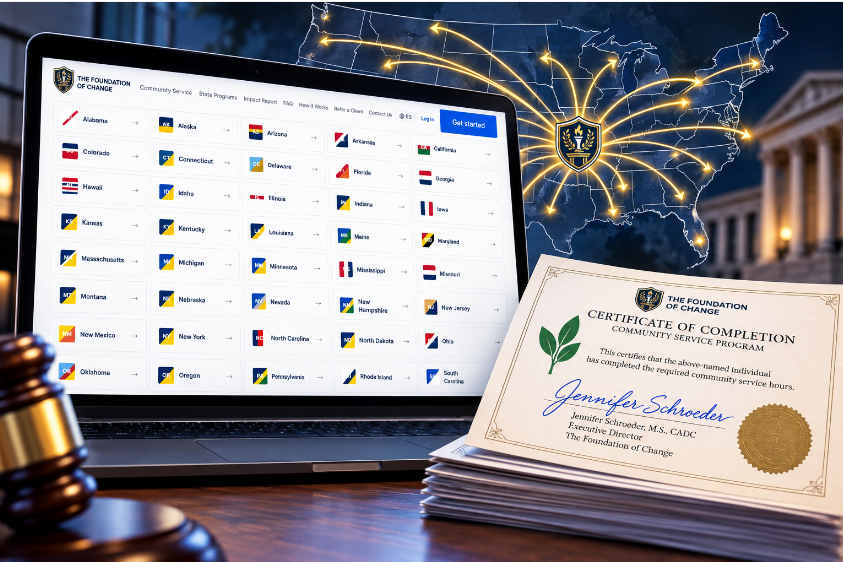

On paper, everything can look legitimate.
A defendant has been ordered to complete community service.
A nonprofit organization appears to accept the defendant into its program.
Later, the defendant returns to court with documentation bearing the organization's name. The document reports that the required hours have been completed.
One hundred hours.
Two hundred hours.
Perhaps more.
There is just one problem.
Nobody actually performed any work.
It isn't merely a hypothetical weakness in the community-service system.
Federal prosecutors have encountered exactly this kind of scheme and it keeps reappearing every few years.
In Louisiana, employees connected with a community organization admitted participating in a system that produced false certificates claiming criminal defendants had completed court-mandated community service when they had not. Money changed hands, official-looking certificates were produced, and the false records were intended to make their way into criminal court proceedings.
The case exposed an uncomfortable vulnerability in court-ordered community service:
Courts frequently have to rely on outside organizations to tell them whether the work actually occurred.
If the organization itself is dishonest, the document intended to prove compliance can become the instrument of the fraud.
Community Service Is Supposed to Mean Work
The premise of community service is straightforward.
Instead of—or sometimes in addition to—other consequences, a court requires a person to contribute a specified amount of labor to the community.
Federal court guidance makes that explicit.
Under federal law, a court may require a defendant to “work in community service as directed by the court.” Federal probation guidance says the supervising probation officer can approve the organization, location and frequency of participation, while the defendant must provide written verification of completed hours.
The same federal guidance recommends selecting a service location with a reliable manager willing to provide accurate information concerning the defendant's attendance and participation.
Verification can include contacting the organization, reviewing its records or actually monitoring the service location.
The reason is obvious.
A certificate is evidence that the service occurred.
It isn't supposed to be a substitute for the service itself.
But That Creates a Vulnerability
Imagine a judge orders someone to perform 100 hours of community service.
The judge probably won't personally watch the defendant perform those 100 hours.
Neither will the prosecutor.
The probation officer may not be standing beside the defendant every afternoon.
Instead, an outside organization can become the court's eyes and ears.
The organization records attendance.
It supervises the work.
It keeps track of the hours.
Then it signs a document telling the court:
This person completed the required service.
The system works when that representation is truthful.
But suppose an organization discovers that some defendants would rather pay money than perform the work.
Now imagine the organization is willing to provide the paperwork anyway.
At that point, the very organization entrusted with verifying compliance can become the mechanism for defeating it.
Federal Prosecutors Found Exactly That in Louisiana, Tennessee, and now in Michigan
The Acadiana Outreach case provides a remarkably clear example.
Federal prosecutors said an employee of Acadiana Outreach began producing false community-service certificates while working as a case manager.
The certificates purported to confirm that individuals had completed court-mandated community service.
They hadn't.
According to the Justice Department, former case manager Angela Degeyter admitted producing more than 50 false certificates between 2008 and 2009.
She was paid $100 for each certificate.
After leaving the organization, prosecutors said, she continued preparing fraudulent certificates on Acadiana Outreach letterhead. Another employee, Elaine Crump, permitted Degeyter to forge Crump's signature and received payments ranging from $25 to $100.
This wasn't merely informal paperwork passed between private individuals.
The certificates were designed to represent to the criminal justice system that defendants had satisfied court requirements.
According to prosecutors, the false certificates were intended to be filed in criminal court records.
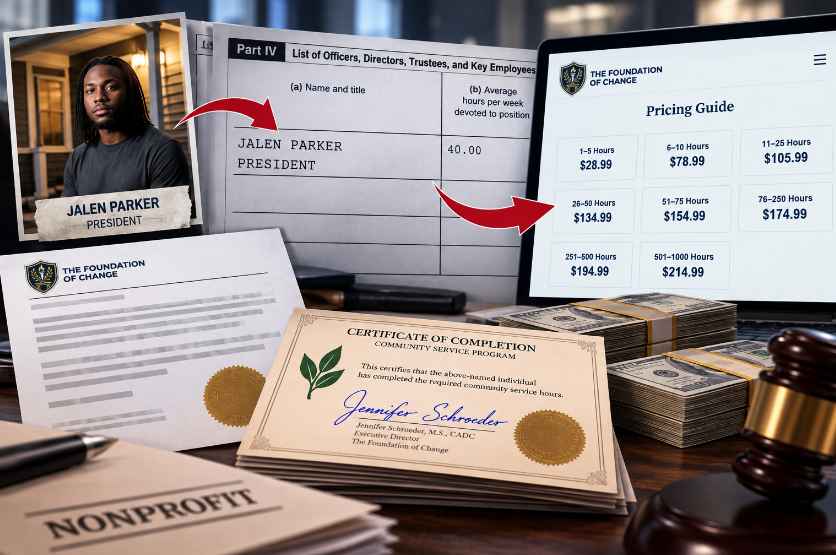
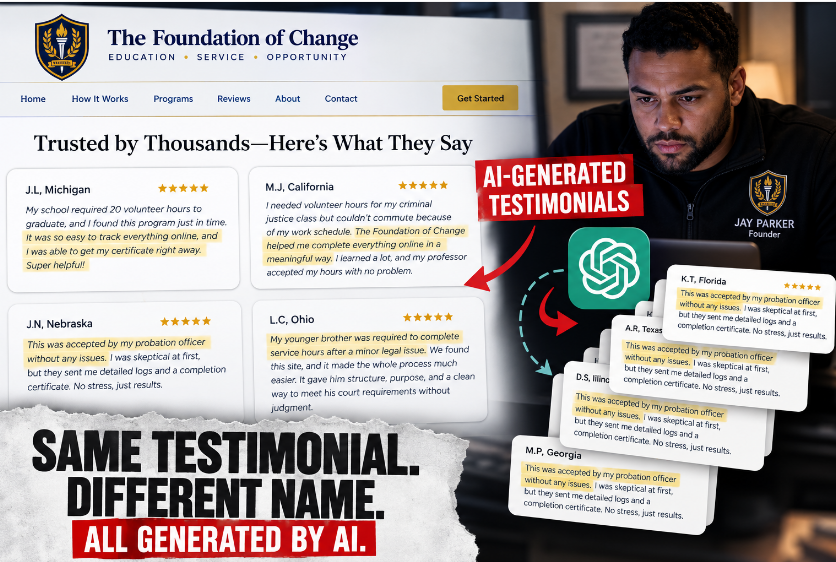
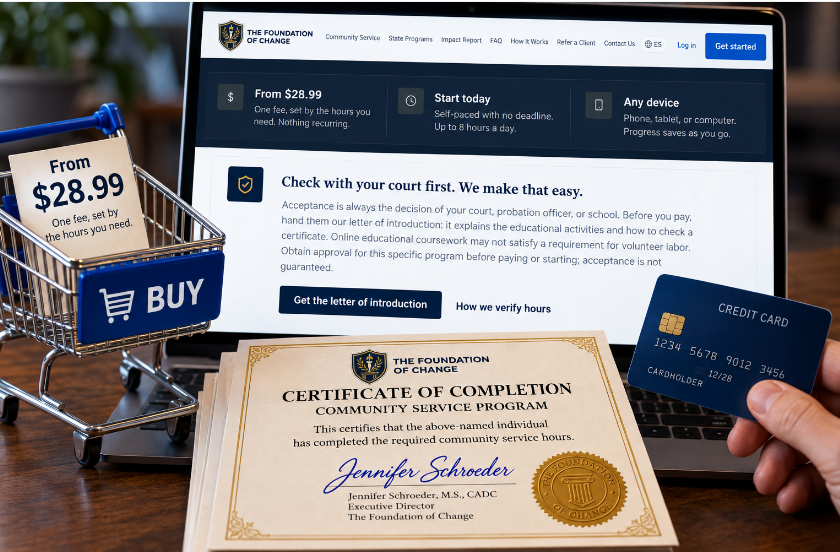
Now, there is an organization in Michigan that has given out hundreds of these certificates purporting to have done labor via an online website which is nothing more than loading a timer and letting it run in order to receive a computer generated certificate after paying upwards of $214 to a man who started the organization name Jalen.
The Certificate Is Totally Fake
This creates an important distinction.
People often imagine a fraudulent community-service certificate as something created by the defendant.
A person completes no work, opens a document editor, invents a charity, adds a signature and submits the forged document to the court.
That is one kind of fraud.
But the more difficult problem is a certificate actually issued by a real organization.
The nonprofit may exist.
Its address may be real.
Its website may be real.
The person signing the certificate may actually work there.
The telephone number may reach the organization.
The organization may even confirm the certificate when contacted.
And the document can still falsely represent that service was performed.
In that situation, verifying that the certificate is authentic doesn't establish that the work is authentic.
Those are two completely different questions.
California Florida, Nevada, and Washington Courts Have Confronted False Work Forms Too
California appellate courts addressed another version of the problem decades ago.
In People v. Tate, defendants submitted community-service referral forms representing that required work had been completed.
The California Court of Appeal described the ordinary process: an organization receiving a defendant's service completes a work-referral form, and the probationer submits it to establish compliance with the probation condition.
The cases involved forms falsely indicating that the defendants had completed their required hours.
The court held that such a false community-service referral form could constitute a false instrument offered for filing under California Penal Code section 115.
The case demonstrates why the paperwork matters legally.
A completion form isn't merely a souvenir from a nonprofit.
It can be submitted to a government institution for the specific purpose of establishing that a judicial order has been satisfied.
False information on that document can therefore have consequences extending well beyond the nonprofit that issued it.
The Internet Creates a New Version of an Old Problem
Online programs can legitimately involve real service as well, but they can also make verification more complicated. That concern is illustrated by Activist Legal’s reporting on the Michigan Nonprofit corporation The Foundation of Change’s timer-based online community-service system which is really a for-profit scheme which was ran by a single man until recently.
The website can enroll someone automatically.
A timer can run without any input from the user.
The database adds hours.
Software generates a completion document with a computer-generated signature.
The certificate can be downloaded without anyone from the organization ever physically meeting or talking to the participant.
What did the participant actually do for the claimed hours?
The answer in this case, is nothing, the technology surrounding the transaction doesn't transform inactivity into community service. And the foundation is registered as a charity, but it doesn't perform any charitable work.
A Timer Isn't Work
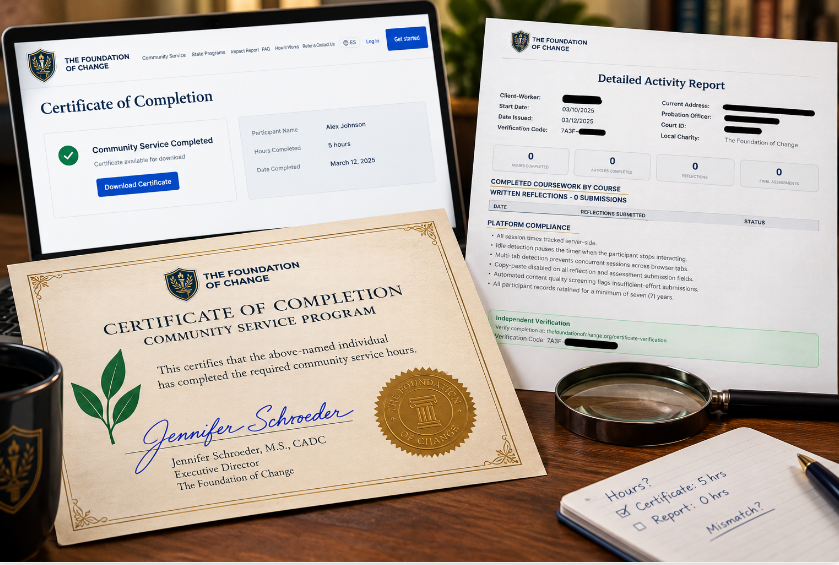
A timer can measure how long a browser page remained open. Activist Legal has separately examined Foundation of Change certificates associated with a system in which credited time can accumulate through an online timer.
It cannot, by itself, establish what the person did during that time.
The distinction matters.
A person can leave a webpage open.
A computer can continue running.
A database can continue accumulating time.
Eventually, software can report that five, ten or fifty hours have elapsed.
But elapsed time is not necessarily performed labor.
If community service requires work, a verification system has to establish more than the passage of time.
It has to establish that the participant actually performed the activity being credited.
View this video showing that you can earn time with The Foundation of Change without having to do ANYTHING...
Fabricated Work Logs Make the Problem More Serious
The problem becomes more serious when documentation does more than record elapsed time.
A completion record may describe activities, assignments, reflections, assessments or other work supposedly performed by the participant.
If those activities did not actually occur, the issue is no longer simply whether a timer accurately measured elapsed time.
The issue becomes whether the documentation itself accurately describes what happened.
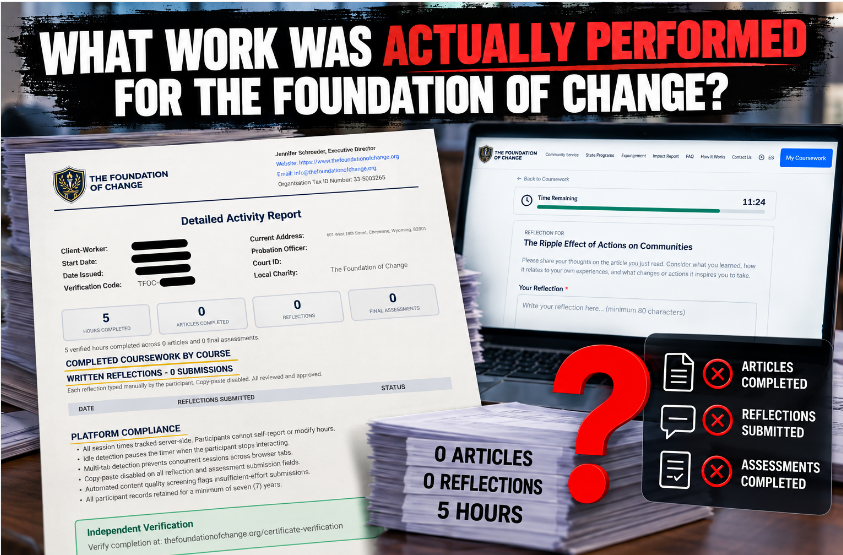
The same is true if a system allows users to simply select or purchase a number of hours and then produces documentation suggesting those hours were earned through work. Activist Legal has examined that issue in its reporting on the path from a Foundation of Change Google advertisement to a community-service certificate.
At that point, investigators can compare the certificate against the underlying records.
What assignments were completed?
What work product exists?
Who supervised it?
When was it performed?
Does the underlying evidence support what the certificate tells the court? That question is central to a documented example in which a Foundation of Change certificate reported completed community service while the associated activity record showed zero articles, zero reflections and zero final assessments.
Courts Don't Have to Accept a Certificate at Face Value
A certificate can look official.
It can contain a nonprofit's name.
It can contain a signature.
It can include a verification number.
It can even be confirmed through the organization's own website.
But those features primarily establish that the organization issued the document.
They do not necessarily establish that the underlying work occurred.
That distinction is important because an organization can verify its own records.
If those records accurately document real work, verification can be useful.
If the records themselves are inaccurate, however, confirming that the certificate matches the database simply confirms that two records agree.
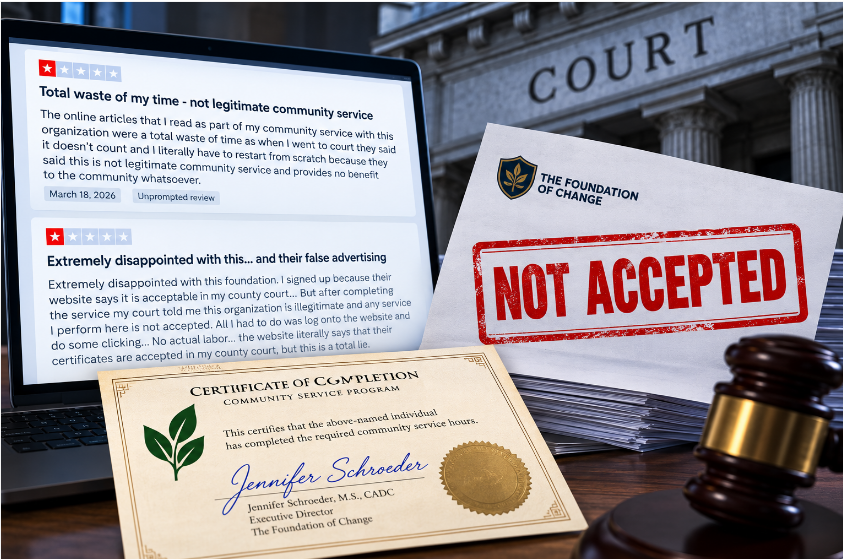
It doesn't independently establish that the represented labor occurred. That distinction is also relevant to Activist Legal’s reporting on Foundation of Change certificates reportedly rejected by courts, despite the organization’s court-approval marketing.
Nonprofit Status Doesn't Prove the Hours Are Real
The word nonprofit can sound reassuring.
It may suggest that an organization has been vetted or that its records should automatically be trusted.
Legally, however, nonprofit status doesn't certify that every representation an organization makes is truthful. Activist Legal has separately examined what charitable work participants in The Foundation of Change actually perform.
It describes an organization’s legal structure and, in some cases, tax status. Related reporting has also examined The Foundation of Change’s early one-director governance structure and fee-based certificate operation.
It does not independently establish that a particular participant performed a particular number of community-service hours.
That still depends on the underlying evidence.
A legitimate nonprofit should be able to explain what service was performed, how participation was monitored, how hours were calculated and what records support the final certification.
The Real Question Is What's Behind the Certificate
Community-service verification ultimately depends on evidence.
A certificate is useful because it summarizes that evidence.
But when the accuracy of the certificate itself is in question, the inquiry has to go deeper.
Who supervised the participant?
What work was assigned?
What was actually completed?
What records were created while the work was occurring?
Can those records be independently checked?
Does the organization's database merely repeat the information printed on the certificate, or does it contain underlying evidence demonstrating that the service actually happened?
The Louisiana prosecution showed how easily a seemingly official community-service certificate can become part of a criminal scheme when the people responsible for verification are willing to certify work that never occurred.
The technology has changed since then.
The underlying vulnerability has not.
A certificate can say that community service labor was completed. The important question is whether anyone actually did the work and in the case of The Foundation of Change - the answer is no! View more articles below to learn more.