
The Foundation of Change doesn't just use a website to administer its online community-service program. According to materials reviewed by Activist Legal, artificial intelligence was used extensively in creating the enormous collection of material participants encounter while accumulating community-service hours.
The scale is striking.
Activist Legal's review identified more than 9,000 pages of material associated with the online program. Participants can load these materials in a web browser, spend the required amount of time on them and accumulate time that ultimately appears on community-service records.
Yet the Foundation describes what participants encounter in considerably more impressive terms.
In its own Community Impact Report, the organization reported 673 educational topics and described the collection as a “CBT-informed course library.” It says participants read educational articles addressing subjects including accountability, emotional regulation, decision-making and civic responsibility.
Documents directed to courts go considerably further.
“Evidence-Based Cognitive Behavioral Therapy”
In a letter introducing its program to courts, The Foundation of Change states that its curriculum is rooted in “evidence-based Cognitive Behavioral Therapy (CBT) and Restorative Justice principles.”
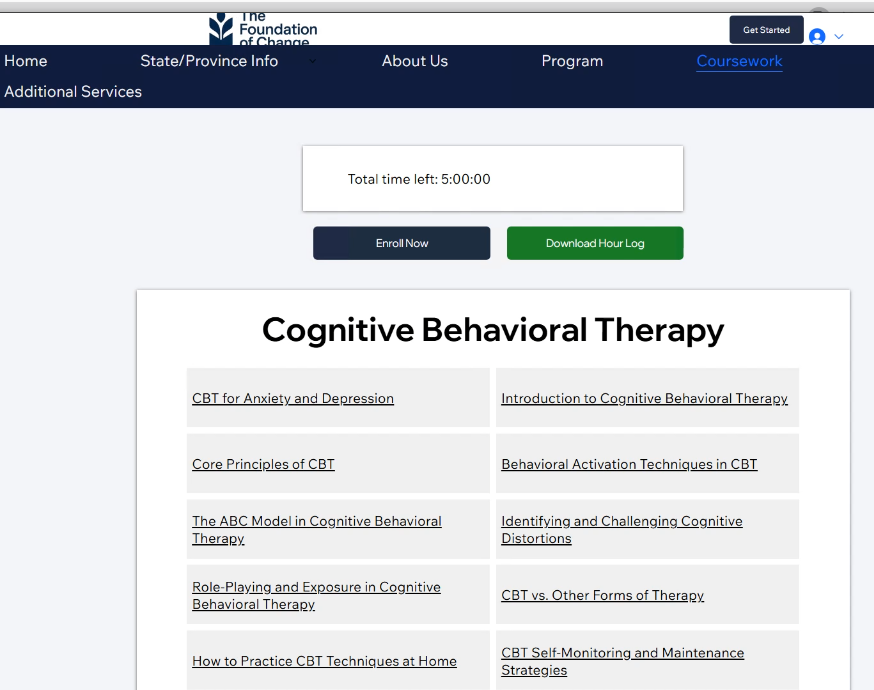
The letter says participants complete structured modules covering anger management, addiction awareness, domestic-violence prevention, emotional intelligence and mental health, personal accountability, crime prevention, decision-making, rehabilitation and other subjects.
Those aren't trivial subjects.
They are areas ordinarily associated with professionally developed educational, behavioral-health or rehabilitative programming.
And that makes the authorship and professional review of the material important.
The Foundation's completion documents identify Jennifer Schroeder, M.S., CADC, as Executive Director. Her name and credentials appear beneath the words “Certified by” on documentation representing participants' completed community-service hours.
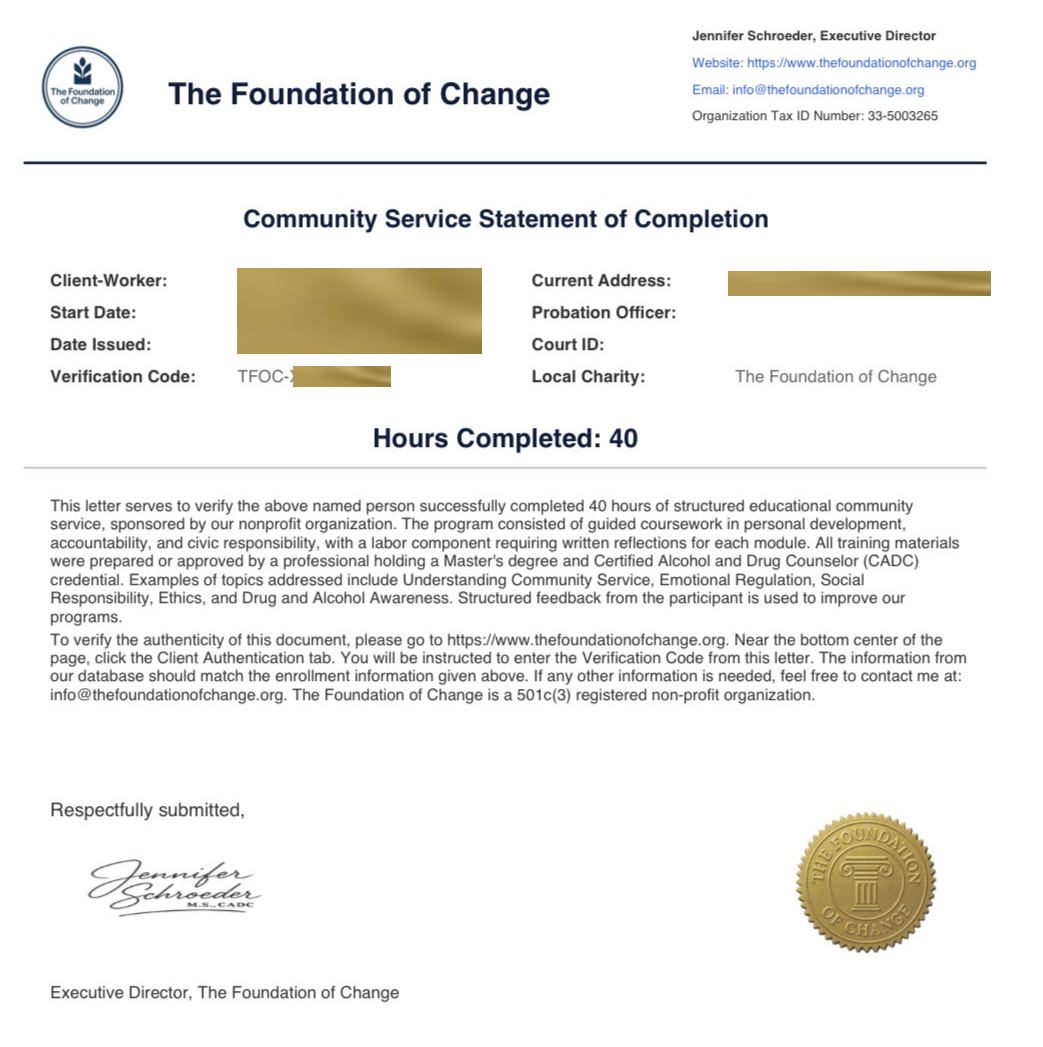
Against that presentation, a reasonable reader could come away with the impression that the Foundation's CBT-related material represents a professionally developed or reviewed curriculum associated with the credentialed executive whose name appears on its certification documents.
But the sheer volume of the material raises a much simpler question:
Who actually wrote and reviewed all of it?
Thousands of Pages, Generated at Machine Scale
Activist Legal's review found that the participant material extends across more than 9,000 pages and was produced using artificial intelligence.
That matters because AI can produce enormous quantities of polished educational material extraordinarily quickly. It can explain cognitive distortions, anger management, addiction, relationships, emotional regulation and virtually any other behavioral-health subject on demand.
But generating text about Cognitive Behavioral Therapy is not the same thing as having a qualified professional design, review and approve a CBT curriculum.
And a webpage sounding therapeutic does not establish that the information on it has been individually reviewed for clinical accuracy.
If thousands of pages were generated through AI, the important question isn't simply whether artificial intelligence was used. AI is now routinely used to assist with writing and website development.
The question is what human professional reviewed the resulting material before participants were directed to rely upon it and courts were told that the curriculum was rooted in evidence-based CBT.
Jennifer Schroeder's Name Carries Weight
That question becomes more significant because Schroeder's name and credentials don't appear merely on an “About Us” page.
They appear on certification documents.
One Statement of Completion reviewed by Activist Legal ends:
“Certified by, Jennifer Schroeder, M.S., CADC, Executive Director, The Foundation of Change.”
The Foundation's accompanying court letter then describes the organization's coursework as evidence-based CBT and says every module requires active reading and written reflection demonstrating genuine comprehension rather than passive screen time.
The presentation therefore deserves scrutiny.
If Schroeder did not personally author the material, how much did she review?
Did she approve every CBT-related article?
Was the material subjected to an independent clinical review?
Were AI-generated statements concerning addiction, mental health, domestic violence and behavioral therapy checked by qualified professionals before publication?
And if not, what exactly does the presence of professional credentials on the program's certification documents signify?
Reading a Webpage Becomes Community Service
There is another unusual aspect to the system.
This isn't simply a free online educational library where members of the public choose to read articles.
Participants are using these materials to accumulate community-service hours.
The Foundation itself says its system tracks participants' browser activity, requires reading time and uses time-locked assessments. Its court materials say active engagement is mandatory and describe mechanisms designed to prevent participants from simply switching tabs or walking away from the computer.
Its Impact Report similarly says participants read educational articles and submit reflections as part of the program. The organization reported 22,583 submitted reflections and 673 educational topics.
In practical terms, that means material displayed in a browser becomes part of the mechanism through which a participant accumulates time ultimately represented as community service.
The computer serves the page.
The participant keeps the page open for the required period.
The system records the time.
And enough recorded time can ultimately contribute toward documentation representing completed community-service hours.
AI Isn't the Real Issue
There is nothing inherently improper about using artificial intelligence to help build a website or draft educational material.
The concern is disclosure, review and representation.
When an organization tells courts that its curriculum is rooted in evidence-based Cognitive Behavioral Therapy, places a credentialed executive's name on its certification documents, and awards community-service credit through interaction with that curriculum, it becomes reasonable to ask who created the underlying material and what professional review occurred before it was put into use.
The Foundation of Change has demonstrated that artificial intelligence can make an enormous website possible.
The unanswered question is whether human professional oversight grew at the same rate as the content.